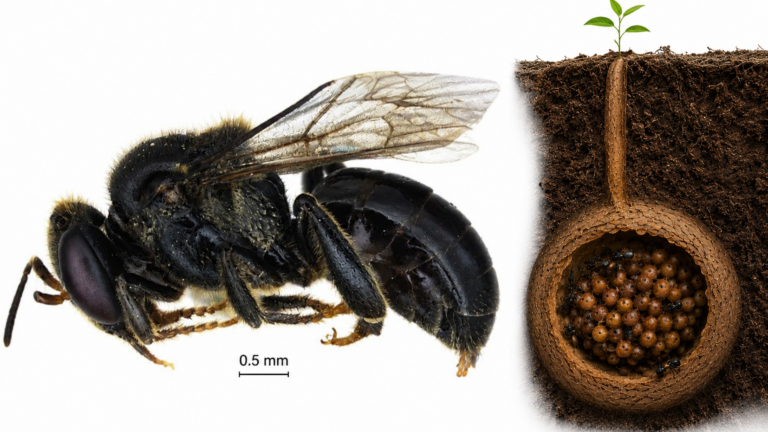
Eighty centimetres beneath the ground somewhere in Medziphema, Nagaland scientists found a tiny entrance to a world most of us would never notice.
It began as a narrow tube disappearing into the moist soil. When they followed it downward, it led them to a colony of stingless bees that were just a few millimetres long, living in darkness beneath our feet.
The bee turned out to be a new species previously not known to science. The researchers named it Tetragonula nagalandensis, after the state where they found it. But figuring out that they had found a new species required looking far beyond what the naked eye could reveal. The researchers examined males and females separately under a microscope, comparing minute anatomical details before finding the features that would distinguish this bee from all its known relatives.
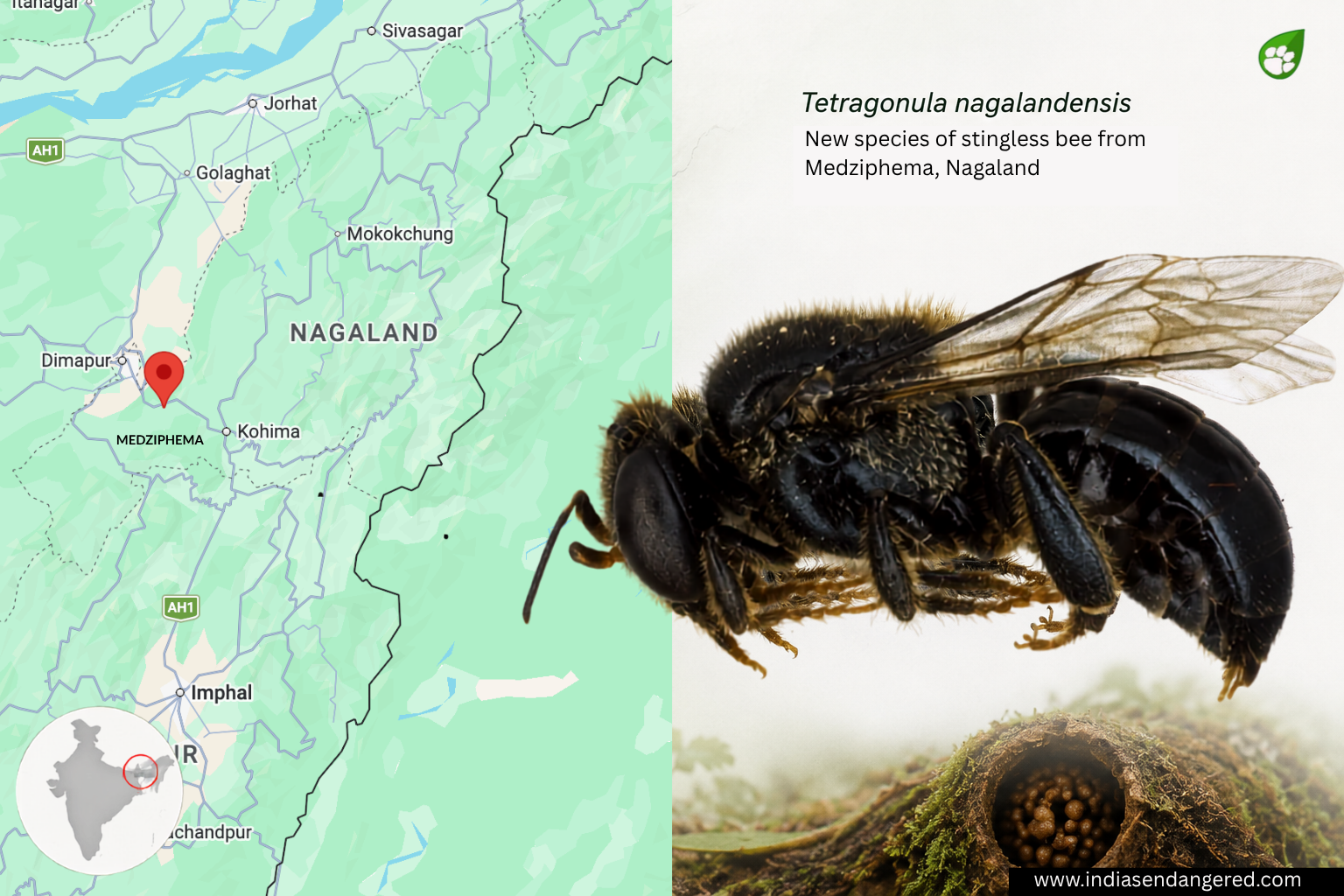
Looking at the Organs of a 5mm Bee
To the naked eye, the females of Tetragonula nagalandensis look much like other stingless bees. They are only about 4.1 mm long. The males are slightly larger, at around 5 mm, and their colouring resembles that of another species, Tetragonula kyrdemkulaiensis.
The crucial clues were hidden in a much smaller place.
Under the microscope, the researchers examined the male’s reproductive structures and found a distinctive C-shaped notch and a sharply curved penis valve that confirmed that what they had found was indeed a new species.
Another unusual discovery was the shape of their subterranean homes.
Read Further: Missing Dragonflies, Key Odonate Species Go Undetected in Western Ghats Survey
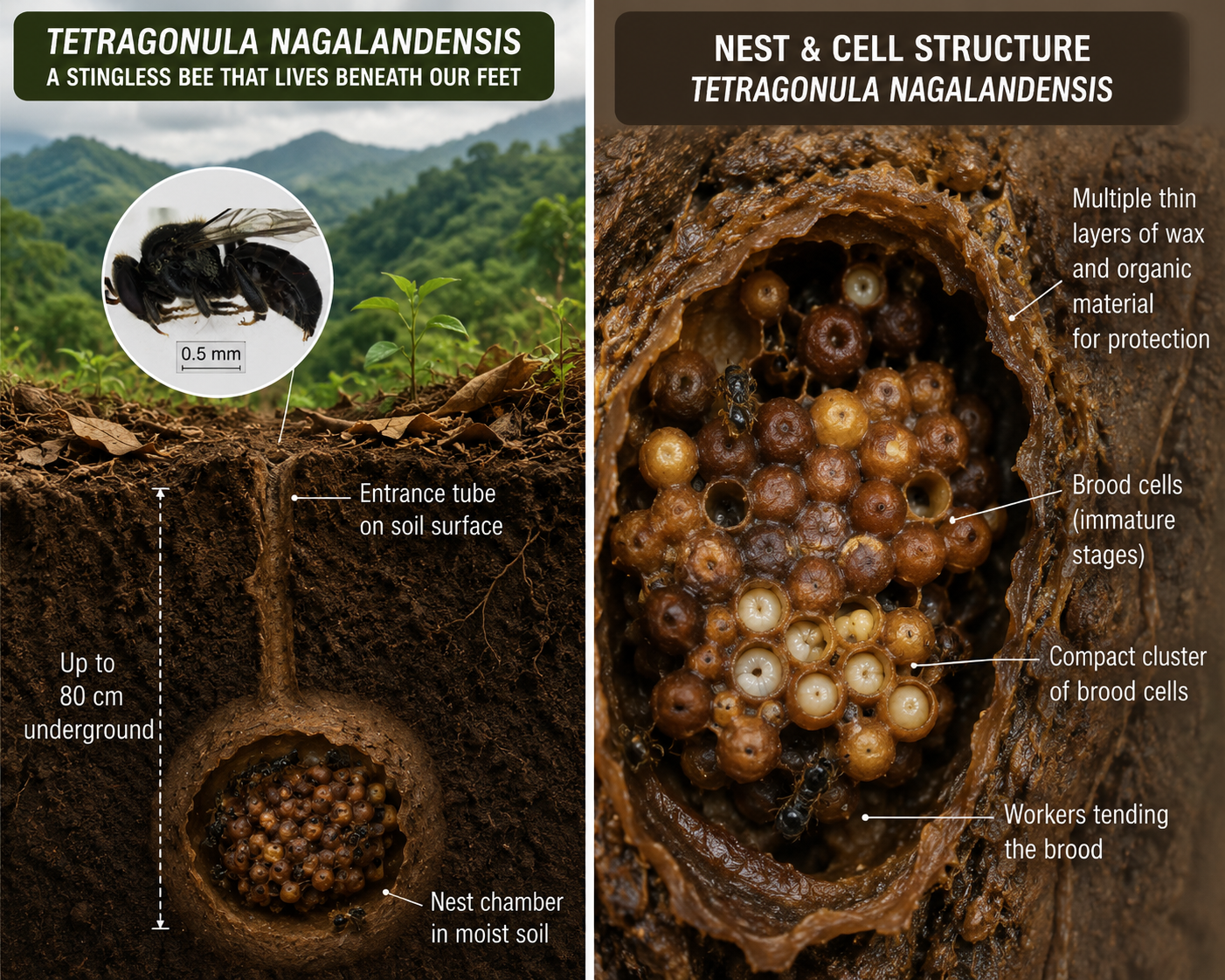
Many stingless bees construct elaborate nests within cavities, trees or other sheltered places. T. nagalandensis, however, lives underground, in a damp environment where the architecture of a nest must contend with moisture and darkness.
Inside the soil, the bees arrange their brood cells in compact clusters rather than in the layered formations seen in many other bees. They protect these clusters with several thin layers made from wax and organic material.
It is an architecture built for a hidden life.
A Different Male Bee Spotted
While the team of researchers were collecting samples they chanced upon another male stingless bee of another species – Tetragonula srikantanathi from the same area.
This may sound like a small thing, but it filled a gap that had remained open since the species was first described in 2021.
T. srikantanathi was discovered in Tripura, and scientists knew it only from females. These are tiny—even by bee standards, measuring around 3.5 mm long—and their orange abdomens helped distinguish them from their relatives.
Now, for the first time, researchers had a male.
The specimen measured about 4.11 mm long, with a head roughly 1.67 mm wide. More importantly, it gave scientists another set of anatomical characters with which to understand and identify the species.
Read More: New Species of Plants and Animals Discovered in India this March (2026)
Tiny Beings but Mighty Landscape Shapers
Stingless bees are easy to overlook partly because they are small and partly because, as their name suggests, they lack the familiar sting of honey bees. But their size belies their ecological importance.
They are busy moving pollen from flower to flower across tropical ecosystems, helping plants reproduce and contributing to the regeneration of forests and other habitats. The plants they pollinate, in turn, support animals that depend on their fruits, seeds and vegetation.
Their colonies also have their own pantry.
Like honey bees, stingless bees collect nectar and pollen and carry these resources back to the nest. Nectar is processed into honey and stored in small pots made from wax mixed with plant resins. Pollen is stored separately and provides food for the colony and its developing young.
The bees are therefore doing two things at once: feeding themselves and moving pollen through the landscape.
That makes their hidden lives worth paying attention to.
India is home to nearly 30 known species of stingless bees, principally in the genera Tetragonula, Lepidotrigona and Lisotrigona. Yet new species continue to emerge from places that, at first glance, might seem thoroughly explored.
Thanks to researchers Shashidhar Viraktamath, Avinash Chauhan, Rojeet Thangjam, and Malar Bui from the University of Agricultural Sciences, Bengaluru, Nagaland University and Central Agricultural University (Imphal) for adding a new name to the world of bees.