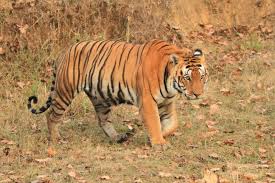
A young tiger from Ranthambore National Park in Rajasthan has moved to the Kuno National Park in Madhya Pradesh. The tiger was spotted by tourists recently in the Titkoli gate area of the park. The two national parks are 90 km away from each other.
Forest officials identified the tiger as RBT-2512, which moved to Kuno about 4 months ago. The movement was natural as the young tiger moved away from its mother to find a new territory for itself.
RBT-2512 was born to Ranthambore tigress T-107 popularly known as Sultana. It is approximately two and a half to three years old.
Sultana is a dominant tigress in Ranthambhore National Park’s Zone 1, who has successfully raised multiple litters. Born to T-39 (Noor), she has been frequently sighted in recent years, including reports of new cubs in 2020, 2022, 2023, and late 2025, with her cubs often spotted in the Amareshwar and Zone 1 areas.
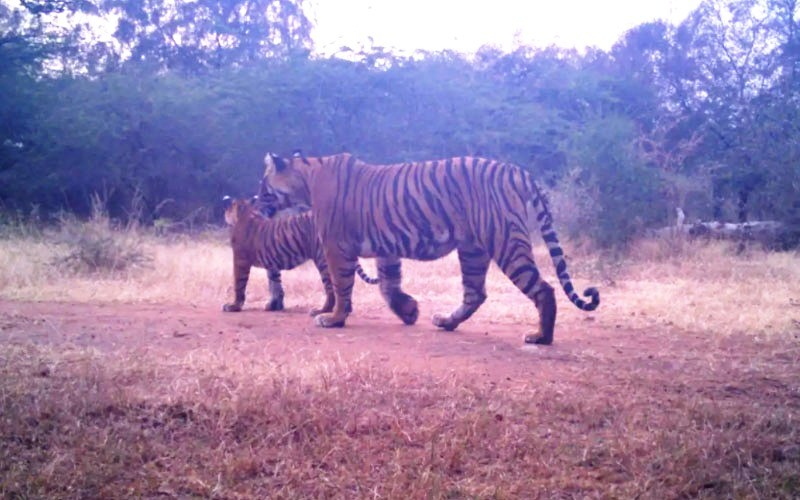
Tiger and Cheetah in the same national park
A senior official told TOI that there is no current plant to tranquillise or relocate the wild cat as its movement occurred naturally. The officer also added that the tiger is maintaining a safe distance from the Cheetahs in the same national park.
Tigers and cheetahs do not usually encounter each other in the wild and this currently is a unique situation where both the predators are in the same area. Usually, tigers are territorial and do not like competition for food resources. That is why they would often fight other tigers in their territory and also leopards. While leopards are chased and killed, tigers do not usually eat them. With cheetahs too, the tiger might want to chase them away or kill them to reduce competition for the same food resources. The forest officers will have to keep a keen eye on both wild cats to ensure the distance remains between the two.
Read More: WildShots: Six Tigers at once
Chambal River Ravine, an important Ecological Corridor
The chambal river flows from North, northeast of Madhya Pradesh to Rajasthan and then eventually to Uttar Pradesh to merge with the Yamuna river. The boundary between Madhya Pradesh and Rajasthan formed by the river ravine is a crucial ecological corridor often used by animals to move between the forests in both states.
In the past, male tiger T-38 had shifted to Kuno and then returned to Ranthambore in 2020 using the corridor. Movement of T-71 in 2012 and T-56 to Madhya Pradesh was also documented.
There are cheetahs too that have used the corridor to move from Kuno to Rajasthan. While for the forest department of the two states this adds a level of complexity to ensure the safety of both types of predators, animals unaware of the state borders continue to utilise their natural instincts to stay or move to better locations in search of new territories or food.
Read More: Simlipal Black Tiger on National Geographic Cover