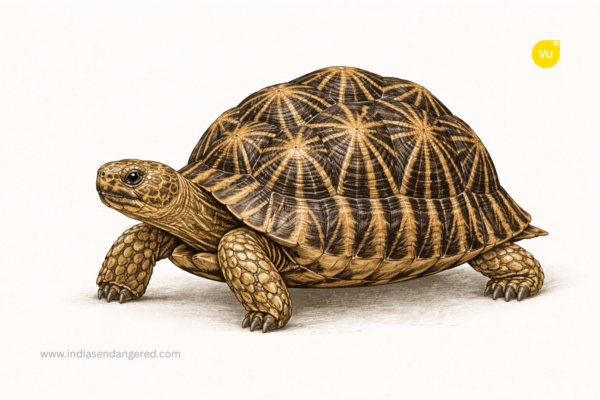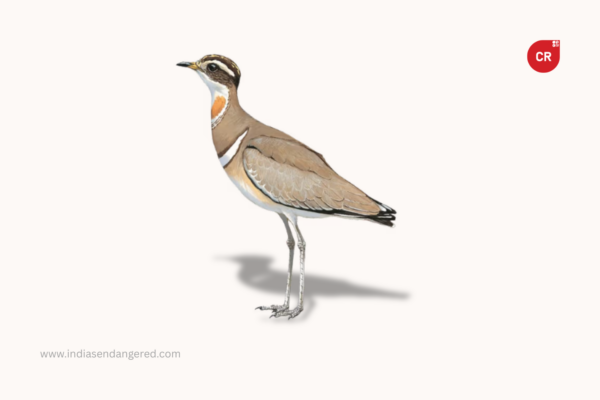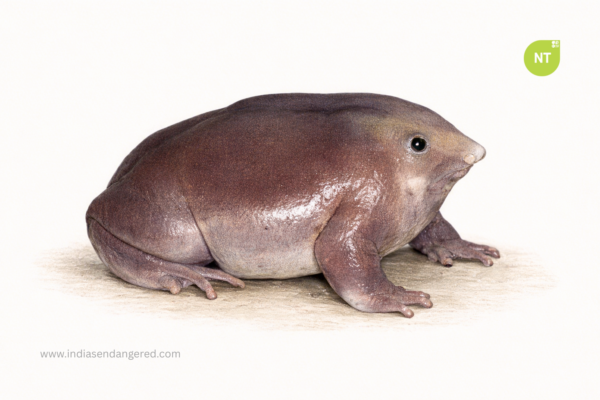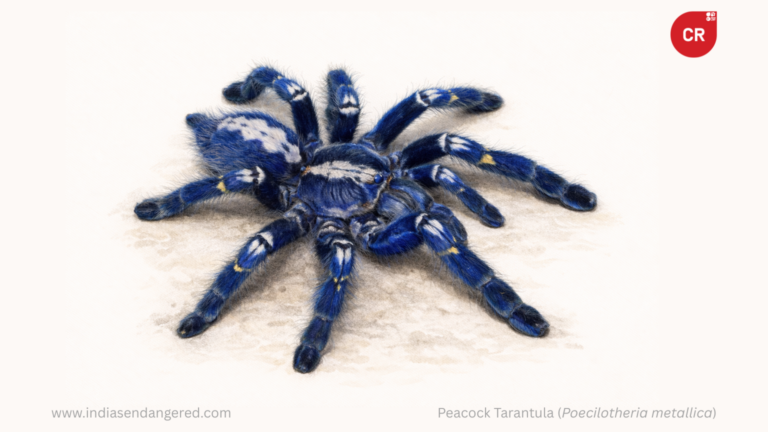
Peacock Tarantula, also known as Gooty Tarantula is species handpicked for Week 5 of our 2026 series 52 Weeks. 52 Threatened Species. To read about the project and other species visit The Jar
In a dry deciduous forest in Andhra Pradesh, where soil and bark dissolve into muted browns and greys, a flash of electric blue feels almost implausible. Inside a tree hollow, limbs folded close to its body, the Gooty Tarantula (Poecilotheria metallica) glows with a metallic intensity that seems ornamental in a landscape shaped by camouflage. Locally known as the Peacock Spider or Sapphire Tarantula, this species bears one of the most saturated blues recorded in terrestrial arthropods.
This colour is neither accidental nor superficial. It is the product of physics, evolutionary contingency, and microscopic architecture — and today, it is inseparable from the species’ precarious survival.
A Colour Without Pigment
For a long time, it was assumed that vivid colours in animals came from pigments — chemical compounds that absorb some wavelengths of light and reflect others. But when researchers began examining blue tarantulas closely, that assumption fell apart.
In 2015, a research team led by Bor-Kai Hsiung published a study in Science Advances showing that the intense blue colour in tarantulas is produced by structural nanostructures in the hairs rather than chemical pigments. Using electron microscopy and spectrophotometry, the researchers found that the hairs of several blue tarantula species — including peacock tarantula — contain nano-structural arrangements of materials with different densities (such as chitin and hair) that selectively reflect blue light through interference, rather than through pigment absorption.
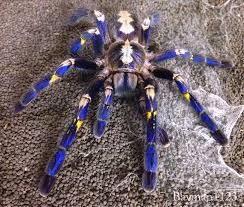
These layers act like microscopic mirrors, reflecting blue wavelengths while cancelling out others. When the hairs were chemically treated or damaged, the blue remained — clear evidence that the colour was created by physical structure, not chemical dyes.
This explains why museum specimens of the Gooty tarantula retain their brilliance decades after being collected. The colour is not something that fades easily; it is built into the architecture of the spider itself.
Hsiung and colleagues also showed that unrelated tarantula species evolved very similar shades of blue independently — at least eight times — through different structural mechanisms. This pattern is compelling evidence of convergent evolution, where distinct evolutionary paths arrive at the same outcome because physics favours certain optical solutions.
Read More: Conversation with the Gooty Tarantula
Do They See Their Own Colour? A New Twist
Tarantulas were long assumed to be nearly colour-blind because their eyes are relatively simple. But in 2020, a team led by Saoirse Foley, William H Piel and Vinod Kumar Saranathan published a study in Proceedings of the Royal Society B that challenges that assumption. Their research surveyed opsins — the light-sensitive proteins that underlie colour vision — across many tarantula species and found a surprisingly rich complement of opsins, more akin to spiders with colour vision than to simple night-active animals.
The study suggested that blue coloration was likely present in ancestral tarantulas, and that it has been lost or regained in different lineages over millions of years. This implies that tarantulas might experience colour in ways previously unimagined, adding a fascinating layer to the question of why they evolved such striking hues.
If tarantulas can see colour, why the blue? Or if they can’t see it well, why did those structures evolve at all? The truth is: scientists still don’t fully know.
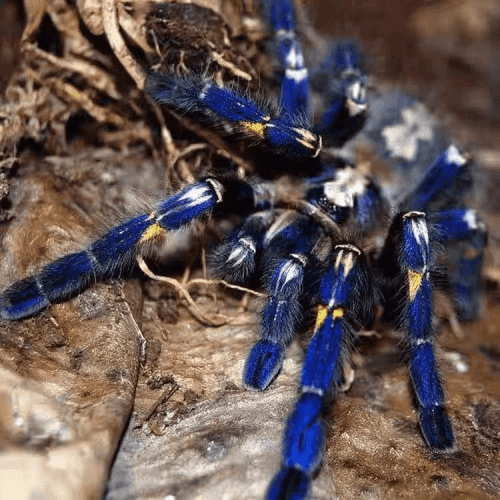
Some hypotheses propose that the blue may aid camouflage in certain light conditions, or serve in subtle signalling to predators or conspecifics. The 2020 opsin research raises the possibility that colour perception is more relevant than previously thought, but data on behavioural responses is still lacking. What is clear is that simple answers — “blue for mates” or “blue for warning” — do not fully capture the mystery.
From Forest Canopies to Human Technology
The same nano-structures that produce blue in tarantula hairs have caught the attention of engineers and materials scientists. Research inspired by these biological designs has led to synthetic structural colours that do not fade like pigments and maintain colour over wide viewing angles, with potential applications in displays, textiles, and coatings.
In that sense, P. metallica is more than an endangered spider. It is a model of biological design, offering lessons in optics that humans are still learning to replicate.
Peacock Tarantula is a Species at Risk
While scientists debate function, the Gooty Tarantula’s future is not theoretical.
According to the IUCN Red List, Poecilotheria metallica is classified as Critically Endangered due to its extremely restricted range and highly fragmented habitat. Mature trees with natural hollows — the only places these arboreal spiders make their homes — have become scarce because of logging, land conversion, and fuelwood collection.
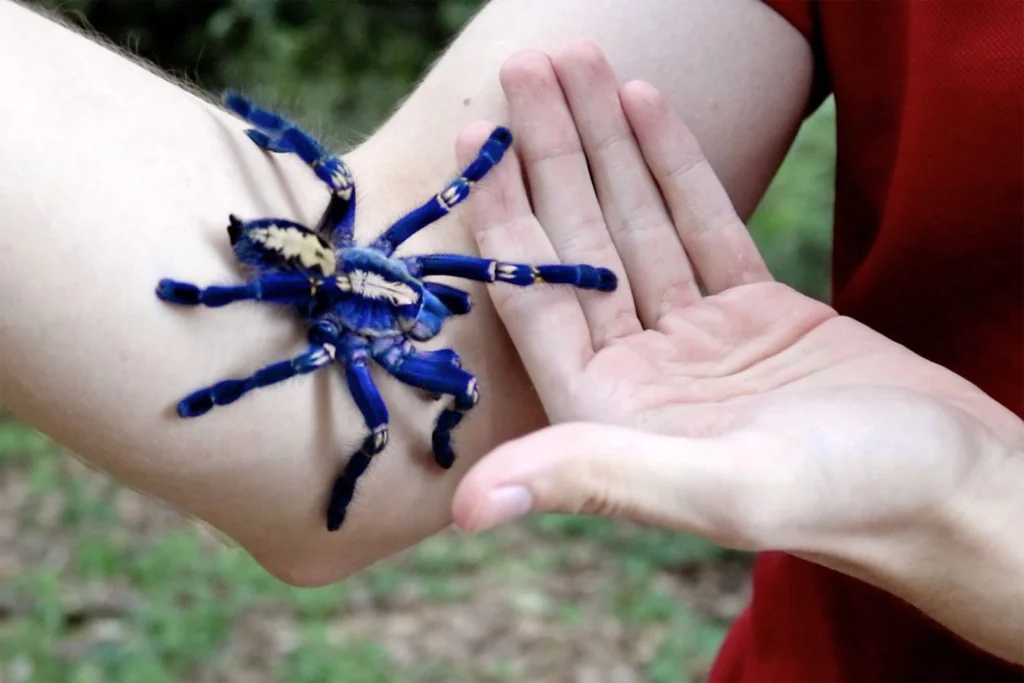
The species’ striking blue has also made it a target of the illegal wildlife trade. Collectors prize individuals with the most intense colour, and even when trade is prohibited, removals from the wild continue. Every spider taken represents a disproportionate hit to an already tiny population.
Here, colour becomes a double-edged sword: a natural wonder that increases both scientific attention and exploitation.
What makes the story of the Peacock Tarantula even more unsettling is its silence. Poecilotheria metallica has not been reliably recorded in the wild for years, despite targeted surveys in its known range. Whether this absence reflects extreme rarity, highly cryptic behaviour, or a population slipping quietly towards extinction is still unclear. What is certain is that a species that once forced scientists to rethink colour, vision, and evolution may now exist only as memories, museum specimens, and scattered individuals in captivity. If conservation action comes too late, the mystery of its blue may remain solved — but the spider itself gone.
Read More: On the Trail of Lost Species
Species at a Glance: Peacock Tarantula
- Scientific name: Poecilotheria metallica
- Common names: Peacock Tarantula, Gooty Tarantula, Peacock Parachute Spider
- IUCN Status: Critically Endangered (CR) — listed on the IUCN Red List due to extremely restricted range and ongoing threats.
- Population (India): Unknown — no formal population estimate exists; wild numbers are inferred to be very limited and declining given threats and tiny range.
- Range (India): Endemic to India’s Eastern Ghats; historically known from a small, highly fragmented forest area between Nandyal and Giddalur (Andhra Pradesh), and occasional records suggest possible extension into nearby forest tracts in the region.
- Habitat: Dry deciduous and degraded forest where the species lives arboreally in tree hollows and bark crevices.
- Major Threats: Severe habitat loss and degradation from logging and fuelwood collection; illegal collection for the pet trade also poses pressure.
- Conservation: Critically Endangered status highlights urgent need for habitat protection and stricter controls on wild extraction.