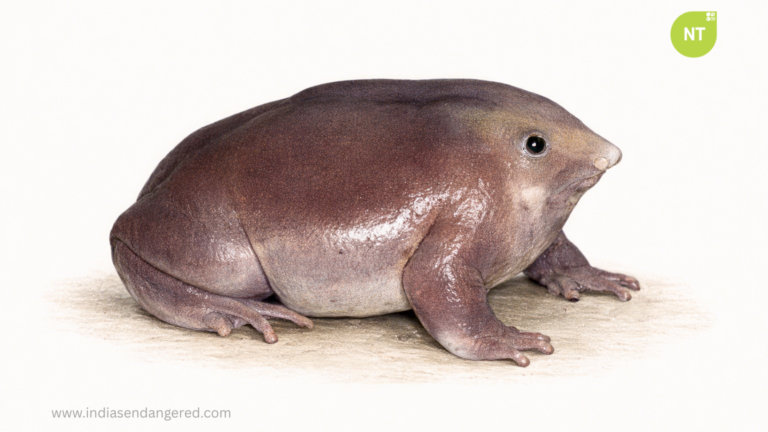
Purple Frog is species handpicked for Week 4 of our 2026 series 52 Weeks. 52 Threatened Species. To read about the project and other species visit The Jar
According to Kerala folklore, the legendary King Mahabali was granted a boon by Lord Vishnu that allowed him to rise from the underworld and visit his kingdom and subjects once every year. This annual homecoming is celebrated across the state as Onam, marked by joy, colour, and collective remembrance.
Interestingly, there is a frog found around the same region of the Western Ghats that follows a strikingly similar rhythm. It leaves its underground abode for a few days every year, stays above ground for a brief period to breed before returning into the subterranean world.
Appropriately named the Mahabali Frog, it is an affectionate tribute to the beloved king, bound to him by this shared, fleeting return to the world above.
The frog has other names too. The purple frog because of its distinctive colour or the pig-nosed frog because of the shape of the nose that helps it survive under the soil. Scientifically it is known as the endangered Nasikabatrachus sahyadrensis.
A Life Extraordinary
Discovered only in 2003 there are many things about this odd amphibian that are still being understood. However, from what we now know, there is no doubt that it is one of the most fascinating species on the planet, found only in the Western Ghats of India.
Take for example the fact that it split from other frogs over 100 million years ago, making it one of the most evolutionarily unique amphibians on Earth.
A Direct Link to Gondwana
This frog is a living reminder of the ancient supercontinent Gondwana. Genetic studies show that its closest relatives are found not in India, but in the Seychelles, revealing that its ancestors existed before India broke away and drifted northward. The Purple Frog has survived continental drift, mass extinctions, and millions of years of isolation. (give a source)
An Almost Entirely Hidden Life
For nearly 11 months of the year, the Purple Frog remains underground, feeding on ants and termites using a highly specialized tongue. This secretive lifestyle kept the species hidden from science until 2003, despite living in one of the most densely populated regions of the world.
A Body Shaped by Life Underground
The Purple Frog’s swollen, almost rubbery body, tiny eyes, and pointed, pig-like snout are not quirks of nature but tools for survival. Its streamlined shape and hardened limbs are adaptations for a fossorial life, allowing it to push through compact soil with ease, while reduced eyesight reflects a world spent almost entirely in darkness.
A Breeding Window Measured in Days
The frog emerges only during the first heavy monsoon showers, often for less than a week. Males call from underground burrows, females briefly surface to mate and lay eggs in seasonal forest streams, and both vanish again before predators or drying conditions can take their toll.
Built for Extreme Beginnings
Its tadpoles develop in fast-flowing, rocky streams where few other frogs can survive. Equipped with a powerful sucker-like mouth, they cling to rocks in torrents of rushing water, avoiding competition while enduring one of the harshest nurseries in the amphibian world.
Here are two very interesting videos that will tell you more about the species.
If Prey has Adapted, so has the Predator
One of the most interesting studies that were done on the purple frog was published in 2021. For a decade, between 2012 and 2021, scientists studied the predators of the adult frog and its tadpoles in Kerala’s Thrissur Forest Division right when it comes above the soil for its mating period.
They found that its predators like the brown fish owl and the checkered keelback snake had changed their routine and positioned themselves in areas where they would be able to wait and hunt the frogs easily.
When the Owl Comes Hunting
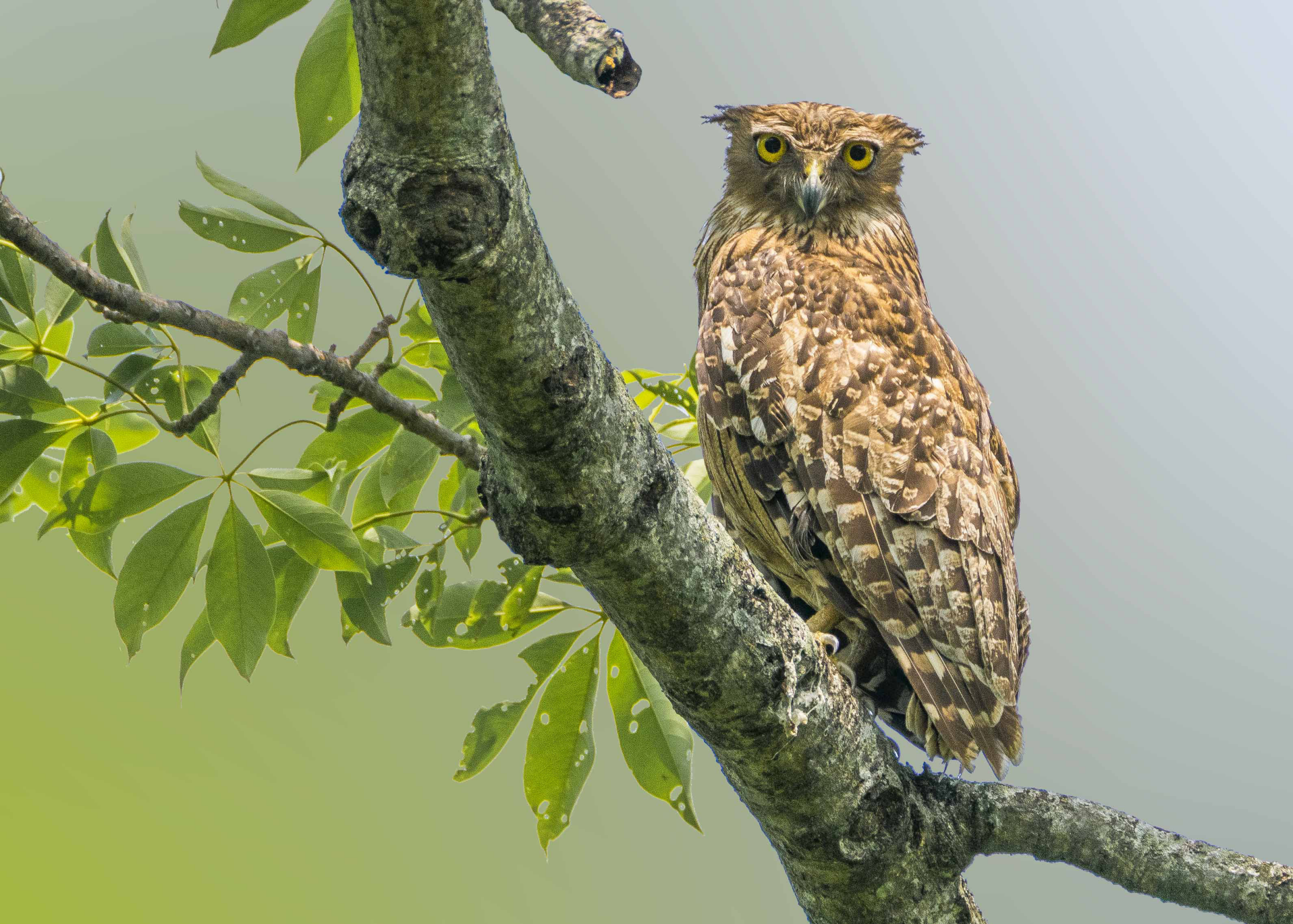
While studying the purple frog and its habitat researchers Sandeep Das, Pulikunnel Syed Easa , Nithin Divakar, Ashish Thomas, and Benjamin Tapley found dead female Purple Frogs repeatedly during the breeding season along short stretches of seasonal forest streams.
One night, the researchers saw what was happening.
A brown fish owl, which is a nocturnal predator, was catching and feeding on the purple frogs. The owl tore into the frog’s side—explaining the strange pattern seen in the carcasses—and flew off when disturbed, sometimes dropping its prey.
Over several years, researchers observed multiple owls hunting along the same stretch of stream, but only after the first monsoon rains, when male Purple Frogs began calling.
In other words, while the males were calling from underground for the female frogs to know that they will be out soon to mate, the owls were listening too and had positioned themselves right in the same area to gobble up the frogs when they came out!
Snakes Wait for the Meal too
Another dramatic observation that the researchers made was that the checkered keelback snake was found lurking inside rock crevices. These were places where the mating frogs would retreat to, to lay their eggs and the snake had a fair idea about this particular microhabitat.
Even Tadpoles have a Predator in Waiting
Purple Frog tadpoles are specially adapted to life in fast-flowing mountain streams. They cling to rocks with sucker-like mouths, developing in thin sheets of water that seem too harsh for most predators.
Yet even here, danger lurks.
Researchers documented large fishing spiders snatching tadpoles from the water’s edge, dragging them under leaves to be eaten. Earlier studies had already shown predation by aquatic insects like mayfly and caddisfly larvae.
So while the tadpoles avoid competition from other frogs, they are far from invincible.
For years, biologists believed that the Purple Frog’s secretive lifestyle offered strong protection from predators. This research challenges that idea.
Yes, the frog is hidden for most of the year. But when it does appear—briefly, predictably, and in very specific places—it may face intense, focused predation.
For a frog which appears to be laying eggs only once a year, and is endangered with a population found only in one part of the world, this predatory adaptation is concerning.
The Purple Frog is not just another rare amphibian. It represents an ancient evolutionary branch found nowhere else on Earth. Protecting it means understanding every stage of its life, including moments when it is most vulnerable.
This study reminds us of an important truth in conservation biology:
even species that seem well-protected by unusual lifestyles can be at risk—sometimes in ways we only discover by patient, long-term observation.
For a creature that spends most of its life hidden beneath our feet, the Purple Frog still has many secrets to reveal. And some of them are far more perilous than we ever imagined.
Species at a Glance: Purple Frog
- Scientific name: Nasikabatrachus sahyadrensis
- Local name: Mahabali frog, Pig-nosed frog
- IUCN Status: Near Threatened (NT) (IUCN Red List 2022 assessment)
- Population (India): Unknown; no quantitative estimates available (IUCN assessment)
- Range (India): Endemic to the Western Ghats, recorded from Kerala and Tamil Nadu
- Habitat: Fossorial species inhabiting loose, moist soil in forested landscapes, breeding briefly in ephemeral streams during the monsoon
- Major Threats: Habitat modification, stream alteration, localised development pressures
- Conservation (India): Occurs in several protected areas; conservation concern due to restricted range and specialised ecology