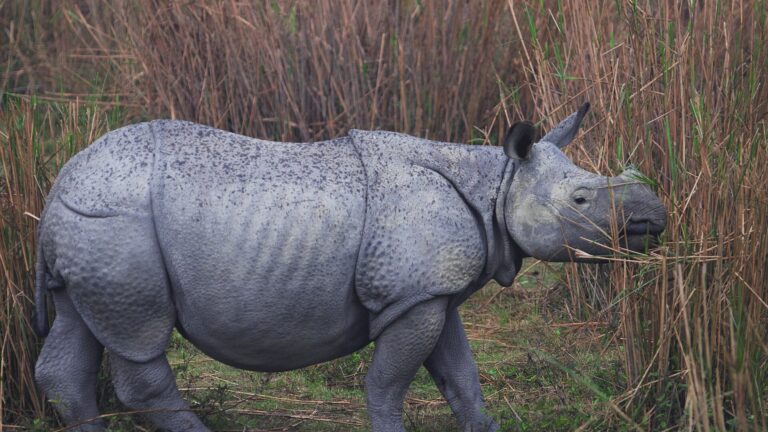
3,500-year-old rhinoceros bone fragments were recently discovered in the Western Ghats. That is over 3,000 km away from the current residence of the Indian rhino in Northeast India, especially Assam.
The bone fragments were discovered during archaeological excavations in 2021 and 2024, confirming research suggesting that one-horned rhinos were once widespread across the Indian subcontinent. However, the rhino populations gradually retreated to northeast India due to long-term climate shifts, habitat loss and growing human pressures. While grasslands and wetlands declined elsewhere, the Brahmaputra floodplains, especially Kaziranga, remained more ecologically stable, allowing rhinos to survive.[1][2][3]
Historical Distribution of the One-Horned Rhino
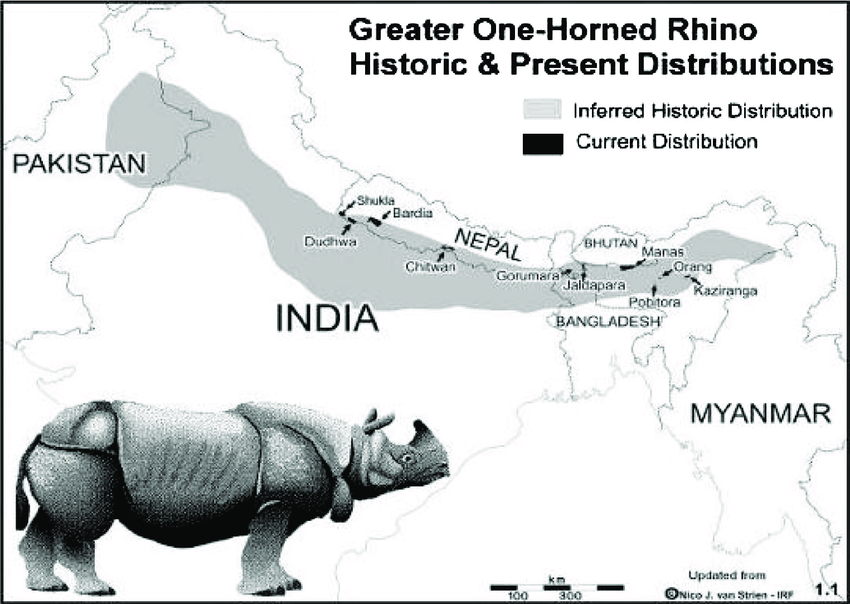
Palaeontological evidence shows that the Indian, or greater one-horned rhinoceros, once roamed far beyond the Brahmaputra floodplains, with its natural distribution spanning much of the Indo-Gangetic plains in North India, Nepal and even parts of Pakistan and Myanmar.
According to genetic studies, ancestral rhinos entered India through the northeast about 1 million years ago, then gradually spread west and southward during periods of favourable climate and expanded grasslands, coinciding with a drop in sea levels.[4]
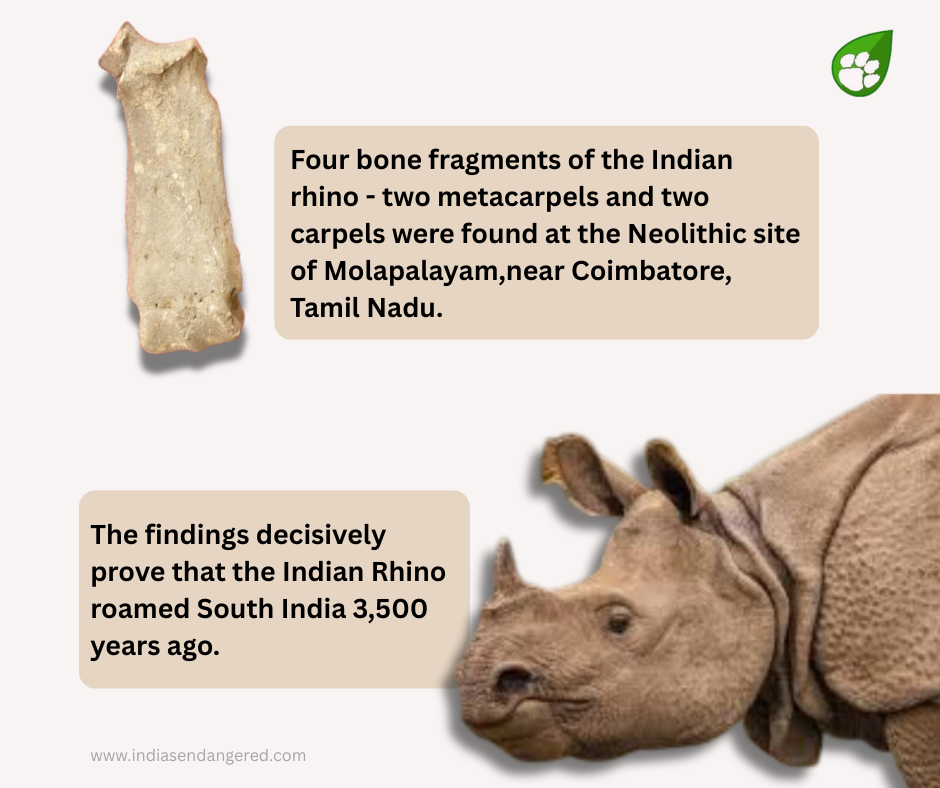
The recent discovery of rhino bone fragments in Molapalayam, a small village near Coimbatore, provides credence to these genetic studies. In fact, this is the third confirmed discovery of rhino bone fragments in South India; similar fragments had earlier been found in the villages of Payyampalli, Kerala and Sathankulam, Tamil Nadu. Dated to 1600–1400 BCE, the remains suggest that one-horned rhinos once lived further south than previously believed and were a part of a richer ancient ecosystem with grasslands and wetlands in South India during the Neolithic Age.
“The animal needs grasslands and marshes. The foothills of the Western Ghats might have had grassland, as a single rhino requires many square kilometres of grassland for food,” said Pramod Joglekar, a retired professor of archaeology at the Deccan College, Pune.
Read More: Rhino Killed in Assam’s Orang National Park, Once Again
Impact of Climate Change, Habitat Loss and Human Interference
Based on the analysis of sediments containing pollen and fungal spores beneath the wetlands of Kaziranga National Park, scientists from the Birbal Sahni Institute of Palaeosciences (BSIP) have speculated that the shift in climate that has been happening for thousands of years has had a major impact on rhinoceros habitats. They reveal that the Kaziranga landscape used to be very different 3,300 years ago, comprising dense forests and having a warmer and more humid climate. Over time, though, grasslands began to expand in the region, making the habitat better suited for herbivores such as rhinos.
North and West India experienced climate deterioration, especially during the Little Ice Age that took place in the medieval period. Meanwhile, northeast India remained more or less climatically stable with less human disturbance, making the region ideal for grasslands and wetlands that could sustain rhino populations.[5][6]
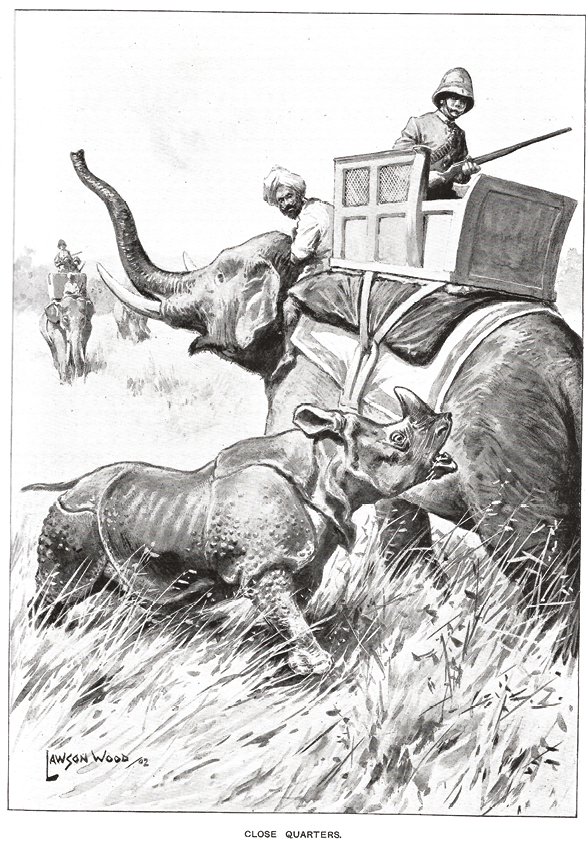
Additionally, increased human pressure through hunting and poaching, changing land use and habitat fragmentation pushed rhinos out of their traditional ranges over centuries. Rhinos used to be hunted extensively in the colonial era, contributing to local extinctions outside of protected forests. In fact, Assam once used to be home to two other rhino species, the Javan and the Sumatran rhinos, both of which were locally driven to extinction due to unregulated hunting.[7]
Success of Conservation Efforts and Hope for the Future for the One-horned Rhino
Even though the species is still largely confined to northeast India, with nearly 80% of India’s total one-horned rhino population residing in Kaziranga, conservation efforts have dramatically increased their numbers in recent years. Of the five extant rhino species, the greater one-horned rhino is the only one to show consistent population growth. According to the 2025 State of the Rhino report published by the International Rhino Foundation, the global one-horned rhino population has risen to 4,075, with 3,323 in India and 752 in Nepal. This is a huge leap from the 1960s, when the population was just about 600.
“This is one of the few conservation success stories in Asia, and India’s progress is remarkable. Back in 2007, the country had just 2,175 rhinos. Today, Assam leads with nearly 2,900,” said Dr Amit Sharma, national lead for rhino conservation at WWF-India.
The greater one-horned rhino is currently listed as “Vulnerable” on the IUCN Red List. More work still needs to be done for the rhino population to truly sustain and grow, and it falls upon the government as well as the locals to protect the species and spread awareness.
Read More: The Women who live alongside Rhinos in India
Citations:
[1], [2], [3], [4], [5], [6], [7], Featured image via wikimedia