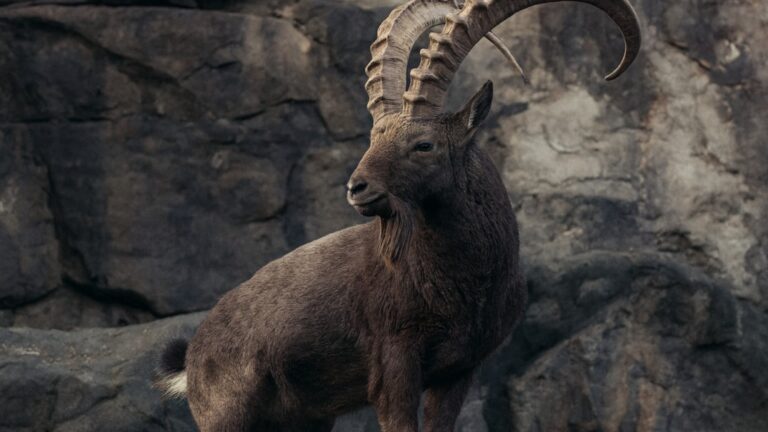
A rare Himalayan Ibex was recently videographed in the remote Gurez Valley of Jammu & Kashmir near the Line of Control. The male ibex is marked near threatened in the IUCN Red List.
The video was shared on X and was filmed by a staff member of the Jammu and Kashmir Wildlife Department at Chek Nallah, a sensitive border area in Bandipora district’s Gurez sector.
Wildlife officials informed that there have been repeated sightings of female Himalayan Ibex with fawns in Gurez. The presence of the male shows that there is a healthy population of the animal in the area indicating a good prey population for predators such as the Snow Leopard, Leopard and Brown Bear.
See the video shared on X,
Three Himalayan Ibex were spotted in Gurez area of Bandipora near Chak Nallah.Wildlife officials safely trapped and later released them at safer locations.Officials say dry weather forced the animals to move towards lower areas in search of food.
— DD NEWS SRINAGAR (@ddnewsSrinagar) December 13, 2025
Report: @Wahidrafiqi2@diprjk pic.twitter.com/ncPnQ57pfb
“Ibex sightings in Gurez at this time of the year are common,” Wildlife Warden for north Kashmir, Suhail Intesar, told Greater Kashmir. “In summer, they move to higher altitudes, and in winter, when frosty conditions prevail at higher elevations, they descend to graze.”
The Himalayan Ibex is also known as the Asiatic Ibex or the Siberian Ibex indicating it’s Asian range. In India it is primarily found in Ladakh, Jammu & Kashmir and in Himachal Pradesh. However as the animal spends most time in the upper Himalayan region, sightings are rare.
The wildlife warden cautioned that the Himalayan Ibex (Capra sibirica) should not be confused with the Kashmiri Markhor (Capra falconeri) another Near Threatened species of wild goat found in India. He said that the Markhor is found only in the Kazinag landscape around Uri in north Kashmir and in Hirpora Wildlife Sanctuary in Shopian district of south Kashmir and the range of the two species do not mix.
In Chenab Valley’s Kishtwar High Altitude National Park, the Asiatic ibex is found in high numbers where they also share the space with domesticated livestock. From May to August, many herders bring sheep to these high-altitude meadows. As pasture is limited in the terrains, the use of the same space by wild goats and domesticated livestock is sometimes unavoidable.
However, there are requests to create species specific core zones in the national park to keep wild and domesticated populations separate.
Species at a Glance: Asiatic Ibex/ Himalayan Ibex / Siberian Ibex
- Scientific Name: Capra sibirica
- Local Names: Tangrol, Sakeen
- IUCN Status: Near Threatened
- Population: Estimated a minimum of 6,000 in Ladakh (Fox et al. 1991a) and 4,000 in Jammu and Kashmir and Himachal Pradesh (Fox et al. 1992)
- Range: Himalayan regions of Jammu and Kashmir, in the Karakorum, Zanskar and Trans-Himalayan region of Ladakh and in the Trans Himalayan and Himalayan regions of Himachal Pradesh, as far east as the Sutlej river ; extends across Central and South Asia
- Habitat: Cold desert landscapes, alpine meadows, rocky slopes, and high-altitude mountains
- Major Threats: Illegal hunting, competition with livestock, habitat degradation, climate change
- Conservation: Protected under India’s Wildlife (Protection) Act; occurs in protected areas such as Hemis National Park