Quick Glance
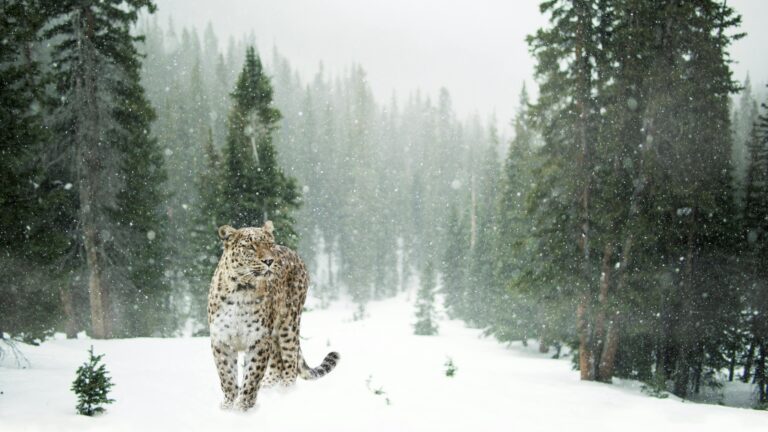
- India’s first nationwide snow leopard survey (SPAI 2019–2023) recorded 718 individuals across six Himalayan states, covering 70% of potential habitat.
- Ladakh hosts the largest population (~477), followed by Uttarakhand (124) and Himachal Pradesh (51) — with HP’s 2025 update showing a rise to 86.
- Improved scientific methods, wider coverage, and community involvement are helping refine estimates and strengthen conservation for this ‘Vulnerable’ species.
For many years, India lacked a single, comprehensive nationwide count of snow leopards. Much of the knowledge came from small regional studies, isolated camera‐trap efforts, and occupancy surveys. The first official nationwide survey ‘Snow Leopard Population Assessment in India (SPAI)’ was conducted between 2019 and 2023 and the report was released in 2024. It showed that India had 718 snow leopards.
The SPAI was coordinated by the Wildlife Institute of India (WII) in Dehradun, in collaboration with range-states and conservation partners such as the Nature Conservation Foundation (NCF) and WWF-India. For the first time roughly ~70% of the “potential snow leopard range” in India was covered, which is approximately 120,000 km² of crucial snow leopard habitat across the trans-Himalayan region.
Field effort and metrics
- Survey teams covered 13,450 km of trails for snow-leopard signs (scats, scrapes, tracks).
- Deployed camera traps at 1,971 locations, accumulating around 180,000 trap‐nights.
- Occupancy recorded over ~93,392 km², estimated presence in ~100,841 km².
- A total of 241 unique snow leopards were photographed during the survey.
State/UT level results of snow leopard population in India

- Ladakh: ~477 individuals
- Uttarakhand: ~124 individuals
- Himachal Pradesh: ~51 individuals
- Arunachal Pradesh: ~36 individuals
- Sikkim: ~21 individuals
- Jammu & Kashmir: ~9 individuals
2025 Update from Himachal Pradesh
The Himachal Pradesh Forest Department released the results of the second state wide survey on 2 October, 2025. It shows an estimated 86 individuals from the state, a 68% rise from the 2021 estimate.
This survey was conducted in partnership with the Nature Conservation Foundation (NCF) and covered 26,000 km² snow leopard habitat in the state.
What is interesting is that the survey also detected other predators in these habitats namely, Himalayan wolf, brown bear, common leopard, red fox, stone marten, mountain weasel, and yellow-throated marten.
Read More: Why do Snow Leopards have such a Long Tail?
For the first time, the survey also reported the presence of Pallas’s cat in Kinnaur and the rediscovery of the woolly flying squirrel in Lahaul.
The increase in the number of the snow leopards in 4 years may be because of better prey availability, better habitats and also better surveying methods.
Why Earlier Estimates were limited
Prior to the national survey, various conservation groups estimated the number of snow leopards in India to be in the broad range of 400–700. But the research coverage was patchy, data sparse, methodologies varied by region. Also, before 2016 almost one-third of the snow leopard range was not accessible and had minimum to zero research attention. High altitude, rugged terrain, low densities, and a very shy and elusive animal made surveys difficult.
The SPAI on the other hand used standardised protocols across states/UTs,
- It significantly improved the camera‐trap effort
- Used a more scientific based occupancy + stratified abundance estimation
- Covered large habitat area (~70%)
- Used forest staff, NGO partners and local community volunteers
The Snow Leopard is ‘Vulnerable’ according to the IUCN Red List. It is also listed in Appendix I of the Convention on International Trade of Endangered Species (CITES) to protect it from illegal trade, and in India, it is listed in Schedule I of the Wildlife Protection Act 1972.
As the methods to correctly access the population and the habitat improve, so do the chances to plan better conservation measures for these beautiful wild cats of the Himalayas.