For nature enthusiast Digvijay Patil a visit to the Sahyadri Wildlife Reserve in Maharashtra turned into a once in a lifetime wildlife encounter. While exploring the buffer zone of the reserve Patil spotted a rare animal that looked like a dog. He quickly captured videos and photos and was delighted to find that the rare animal was a black coloured Dhole or Asiatic Wild Dog.
What Is a Dhole?
Asiatic wild dogs (Cuon alpinus), also called red dogs or whistling dogs, are highly social carnivores known for their cooperative hunting techniques and vocal communication. They are distinguished by a reddish-brown coat, a bushy black tail, and a fox-like appearance.
In India they are found in Karnataka, Kerala, Tamil Nadu, Madhya Pradesh, Maharashtra, Chhattisgarh, and in the North eastern states of Assam, Arunachal Pradesh and Nagaland.
They prefer dense forests, often near rivers and streams, and are also found in mountainous regions up to 5,000 metres.
Read More: Rare Dhole Home Range Studied Using Camera Traps for the First Time
What Makes the Black Dhole So Rare?
The black-coloured dhole observed by Patil is a melanistic variant, meaning it has an excess of melanin, the pigment responsible for dark skin, fur, or feathers. Melanism is a rare genetic condition in wild species, and in dholes, it is extremely rare.
The last confirmed sighting of a melanistic dhole in India was in 1936, in the Gaddesal region of the Coimbatore Forest Division. That sighting was recorded by hunter and naturalist R.C. Morris.
Conservation Status and Protection
Dholes are currently classified as Endangered on the IUCN Red List, making them highly vulnerable to extinction in the wild.
They are also listed under:
- Appendix II of the Convention on International Trade in Endangered Species (CITES)
- Schedule II of India’s Wildlife (Protection) Act, 1972
The estimated global population of dholes is between 4,500 to 10,000, with only 1,000 to 2,000 mature, breeding adults. India is believed to harbour the largest population of dholes, although exact numbers remain difficult to verify due to their elusive nature.
Following the recent sighting, forest officials have stepped up monitoring in the region to ensure the animal’s safety and to gather further observational data.
Read More: Dhole Spotted in Bengal for the First Time
Rare White Dhole Spotted in 2023
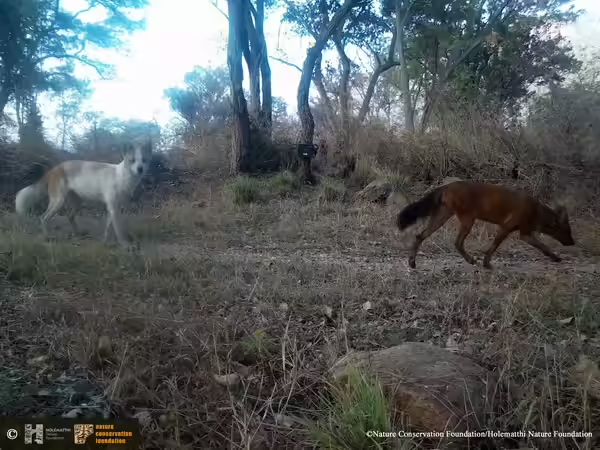
This is not the first time an unusual variation of the dhole has been discovered in India. In 2023, researchers led by Sanjay Gubbi from the Nature Conservation Foundation documented an albino dhole in the Cauvery Wildlife Sanctuary in Karnataka.
Albinism is the opposite of melanism, caused by a lack of melanin, resulting in white or pale colouring. Such rare sightings offer vital insights into the genetic diversity and evolutionary adaptations of wild species.