Quick Glance
- Scientists discovered two unique defence behaviours in Indian frogs — one bites and screams, the other stands tall to scare predators.
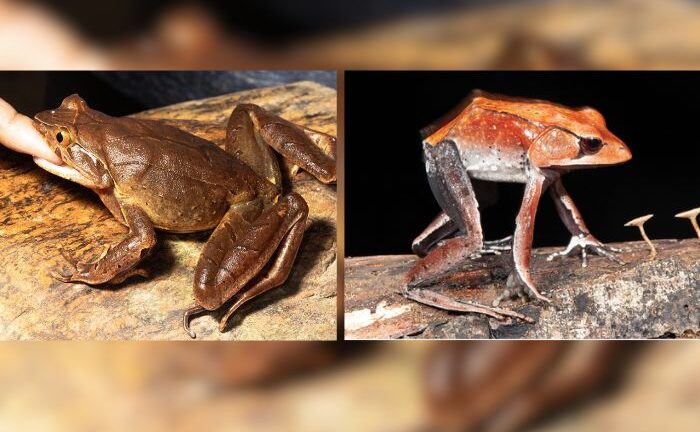
- The Apatani Horned Toad from Arunachal Pradesh shrieks and bites when threatened, while the Bicoloured Frog from Kerala’s Western Ghats lifts itself off the ground in an intimidating stance.
- These findings, published in Herpetology Notes, highlight the diverse and little-known survival strategies of India’s amphibians beyond camouflage and escape.
In the misty under-storey of India’s forests, two seemingly harmless frogs have just added new chapters to the evolutionary playbook of defence. The first, the tiny leaf-litter dwelling Xenophrys apatani (the Apatani Horned Toad) from Arunachal Pradesh, surprises with biting and shrieking when threatened. Its forest-floor cousin from the Western Ghats, the Clinotarsus curtipes (Bicoloured Frog), responds to danger by raising its body off the ground, limbs stiffened, as if announcing: “I’m bigger than you think.”
The study, led by renowned amphibian specialist Sathyabhama Biju and including Tage Tajo, A.N. Dikshit. Akalabya Sarmah, Radhakrishna Upadhyaya K., and Sonali Garg, was published in Herpetology Notes. It documents these behaviours for the first time among Indian frogs.
Read More: 4 New Species of Burrowing Frogs Discovered in India
The Frog that Screams and Bites When Threatened
On the forest floor of the Tale Valley Wildlife Sanctuary in Arunachal Pradesh, the Apatani Horned Toad disappears into its surroundings, perfectly mimicking the dry leaves with its earthy hues and textures. Endemic to this region and found nowhere else in the world, the toad relies on its stillness and remarkable camouflage as its first line of defence against predators.

But when the research team was out surveying the area, they accidentally found another defence behaviour of the frog. When prodded with a twig (the team tried to create a threat scenario to understand the frog’s reaction to it) the frog immediately raised itself and inflated its body. While the twig was motionless, the frog continued this stance, as if to warn that it was indeed not a good idea to threaten it.
Next, when the researchers brought the twig a little closer to the frog’s mouth, it immediately produced a warning call and bit the twig!
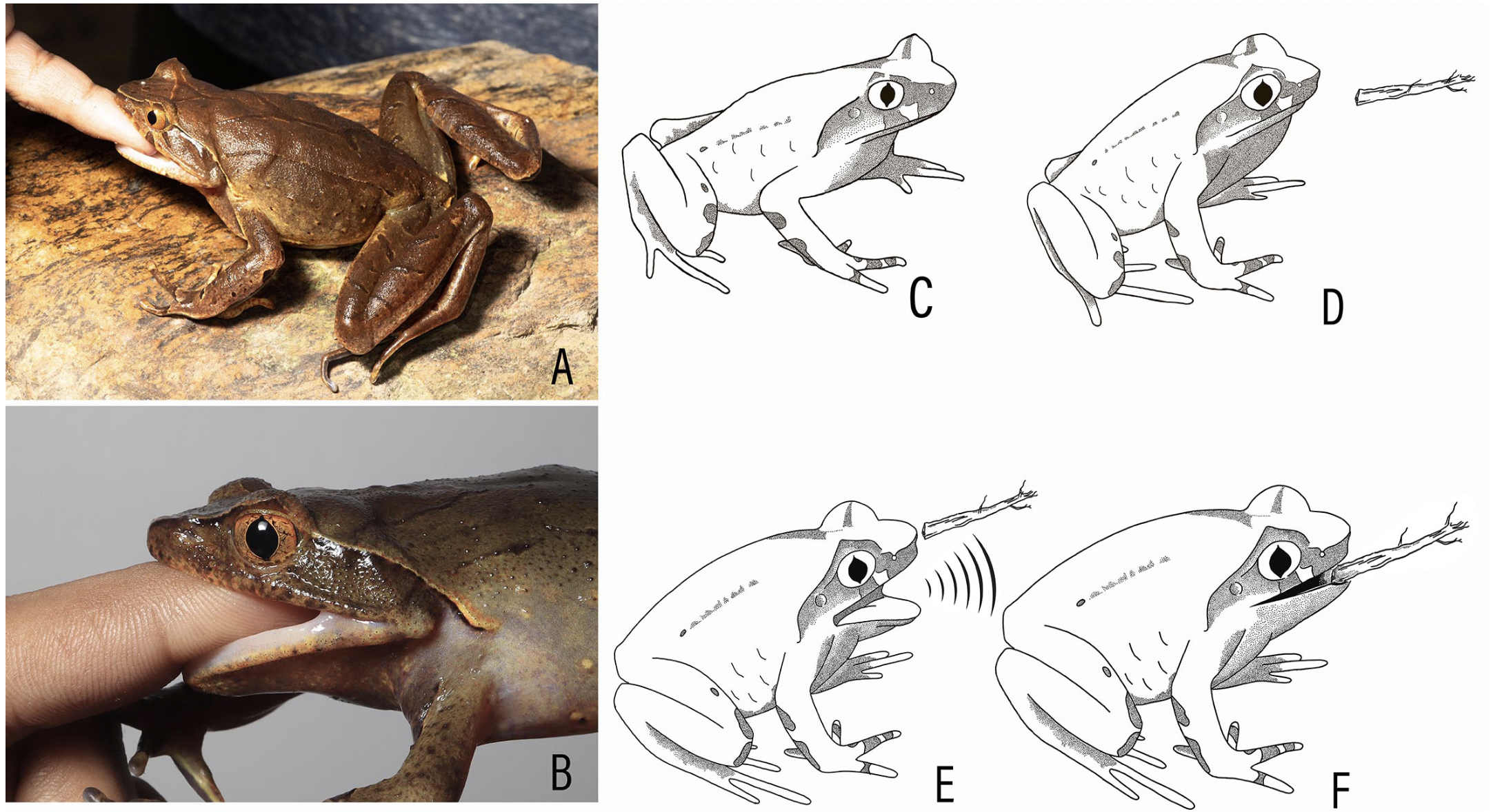
This kind of defence mechanism has not been observed in an Indian frog earlier, although they write “In close contact encounters, biting is one of the most aggressive behaviours observed in frogs, which has been reported in at least 30 species.”
The researchers also add that the bite force of the frog was so great that it took an effort to remove the twig from its mouth. When they tried to lift the frog to photograph it, the same behaviour was seen — distress call, followed by biting on the finger of one of the team members.
Read More: Are There Any Poisonous Frogs in India?
The Frog That Raises Its Body When Threatened
In another part of India, the biodiversity hotspot of Western Ghats, the researchers observed another peculiar defence mechanism of a frog.
The bicoloured frog, found only in Singappara, Siruvani, Palakkad
District, of Kerala has dark blackish-brown limbs and a lighter brown overall body colouration. On a routine photography exercise when the researchers tried to lift one of the frogs, it immediately became alert and raised its body off the ground.
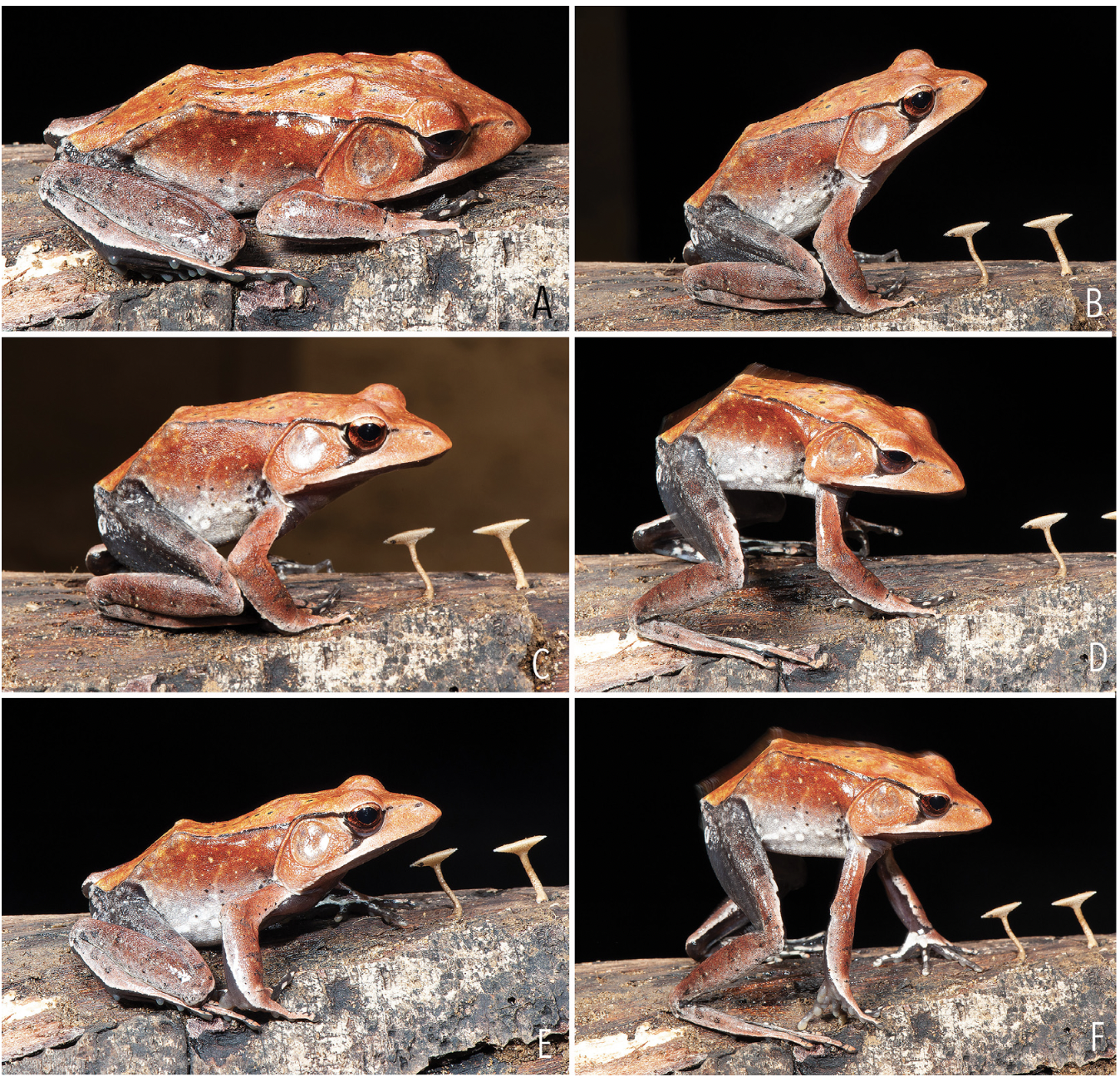
“The adult fully extended its fore- and hind limbs vertically, raising its body off the ground level while its eyes remained wide open.” write the researchers.
They tried to repeat the experiment a few times and got the same results with some individuals repeating the posture 2-3 times to show – I am dangerous!
“This postural display exposed the dark blackish-brown limbs and ventral body surfaces in contrast to the light-brown dorsal colouration, potentially to intimidate a perceived predator, and
continued for about 10 s before the individual returned to its normal posture.”
The researchers add that the posture was not seen in frogs that were in captivity.
“Although frogs are known to exhibit a wide range of defensive behaviours, these are often undocumented,” said Dr Biju to Mathrubhumi. “India has 419 known frog species, yet this is the first record of biting and body-raising defence strategies in any Indian frog.”
Discovering Microhabitats
We often associate frogs with simple escape or camouflage strategies: hop away, freeze, use toxicity, or blend into surroundings. But here are two species that broaden our understanding of amphibian behaviour and remind us that “common” doesn’t mean “well-understood.”
It also points to the fact that species in leaf-litter or forest-floor habitats may have complex behaviours we have not yet discovered. The unique behaviours may help them survive in predator-rich microhabitats, and losing those habitats may erase not just individuals but evolutionary novelties.
Read More: