
India’s legendary Jerdon’s Courser, one of the world’s top “lost birds,” was rediscovered outside its known range in August 2025—ending a 125-year absence from locations beyond Lankamalla hills. A team of birders recorded audio calls of the bird.
The Jerdon’s Courser is a Critically Endangered bird as per the IUCN (International Union for Conservation of Nature) Red List. There are an estimated 50–249 individuals, and they are locally endemic, i.e., found only in the Eastern Ghats of Andhra Pradesh.
A Ghost Bird in India
In the 177 years since they were first discovered in 1848, only a handful of scientists, researchers, and enthusiastic birders have been lucky enough to either hear or see this bird. Owing to its nocturnal habits and incredible ability to remain hidden, the Jerdon’s Courser has earned the reputation of a “ghost bird” – existing, yet rarely seen.
It is perhaps this difficulty in tracking down the bird that makes each news of its sighting or call recording feel like a renewed proof of existence.
Read More: Efforts Made to Save Jerdon’s Courser, One of the Rarest Birds In the World
Early Sightings and Extinction Fear
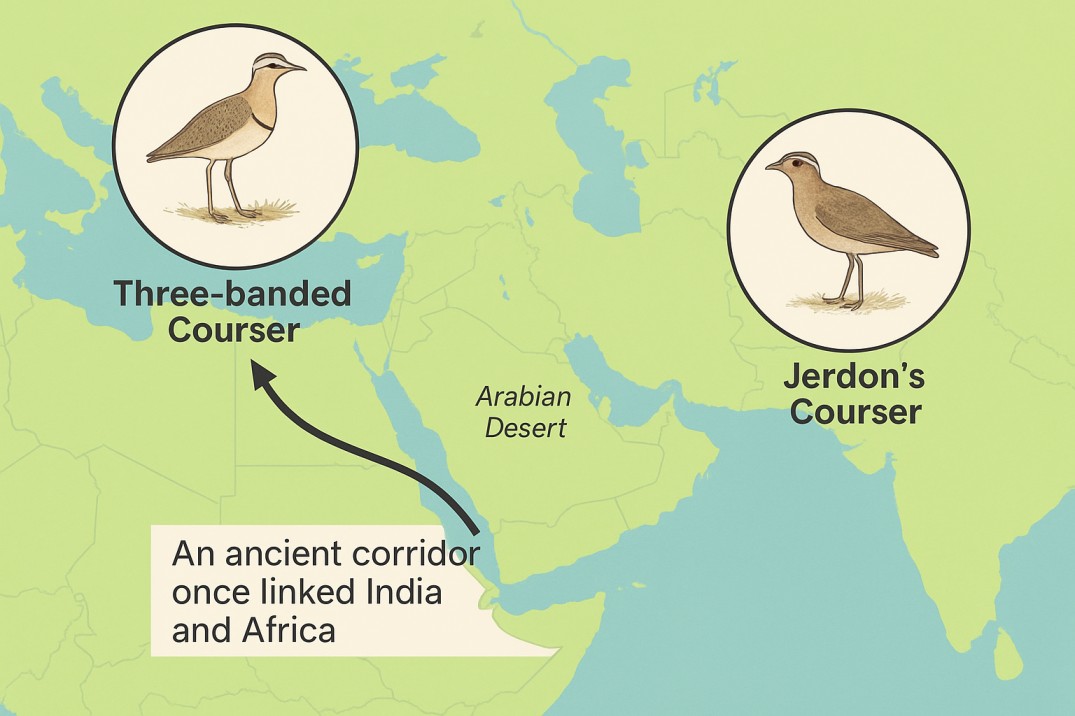
Historically, the Jerdon’s Courser was known from a few places in the Pennar and Godavari river valleys. Seen as a relative of the Three-banded Courser found in Africa, their similarities suggest a common ancestor and that an ancient corridor once linked India and Africa. Over time, this corridor eroded due to the emergence of the Red Sea, the Persian Gulf, and the Arabian Desert.
After 1848, when Dr. Thomas C. Jerdon first recorded the bird in Kadapa district, it was seen again in 1867 and 1871 by W. T. Blanford, and in 1900 by Howard Campbell in the Pennar and Godavari river catchment in Anantpur, Andhra Pradesh. After this, the Jerdon’s Courser was not seen for 87 years and was thought to be extinct.
By chance in 1986, a trapper named Aitana accidentally caught the bird near Reddipalli village in Kadapa district. Bharat Bhushan from the Bombay Natural History Society (BNHS) identified it as a Jerdon’s Courser, prompting authorities to convert the area into a sanctuary—Sri Lankamaleswara Wildlife Sanctuary.
One would think a protected habitat would ensure better sightings of the bird, but in the case of the Jerdon’s Courser, it remains one of those rare gems of nature that reveals itself only to a persistent few.
Between 1986 and 1995, there were a total of eight sightings within the sanctuary by forest officials and researchers using camera traps and acoustic call recorders. Some methods of passive bird observation worked, some did not, as many rallied to catch a glimpse of this nocturnal bird.
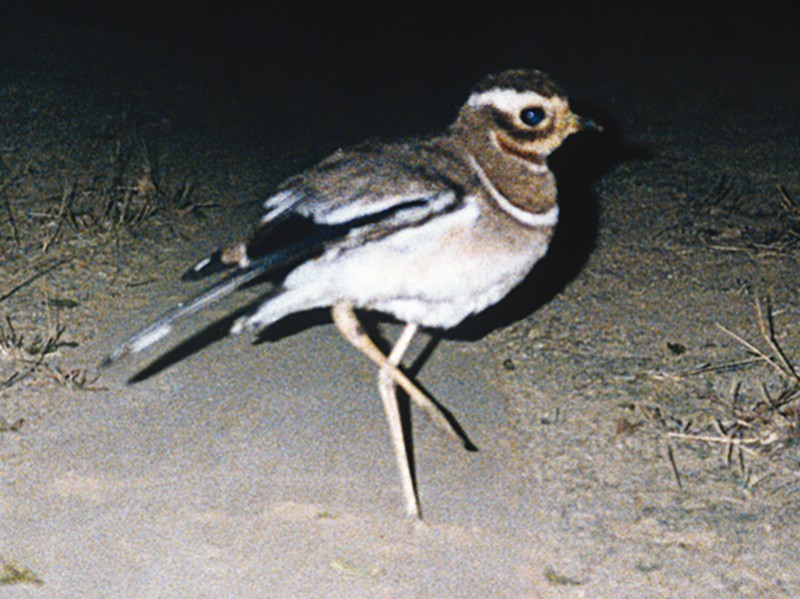
A camera trap photo from 2004 remains the most famous image of the Jerdon’s Courser and is frequently used by conservation websites. Another milestone was in 2001, when scientists P. Jeganathan and Simon Wooten recorded the bird’s call for the first time in Sri Lankamaleswara Wildlife Sanctuary. You can listen to this call here or below,
And then, came the night of 24 August 2025. In the quiet scrublands beyond Lankamalla, birding enthusiast Harish Thangaraj, along with Adesh Shivkar and their field assistant Manoj, picked up a faint but unmistakable call on the Merlin app—the voice of the long-vanished Jerdon’s Courser. It was the first confirmed recording outside the hills in over a century. A few days later, Ronith Urs, Shashank Dalvi, and Pranav joined the expedition, turning a chance moment into a shared celebration of one of India’s rarest birds. This successful recording done through intensive research, fieldwork, and collaboration proved the bird’s survival beyond historical boundaries.
The Way Forward
The Jerdon’s Courser requires a specific habitat: open scrub forests with vegetation such as Carissa species, locally known as Kalivi Chetu. The bird’s Telugu name, Kalivi Kodi, literally means the bird of the Kalivi shrub. It prefers to stay near thorny shrubs for food and camouflage.
Other species also co-exist in this habitat, including rufous-fronted prinias, rock bush-quails, and sandgrouses. Unfortunately, many scrub forests lie outside protected areas and are under threat from eucalyptus plantations, canal construction, livestock grazing, quarrying, and agricultural expansion.
As wildlife biologist Ronith Urs writes in his Mongabay commentary, expanded surveys are urgently needed across Andhra Pradesh districts—Kadapa, Kurnool, Nellore, Prakasam, and Anantapur—using satellite mapping, acoustic tools, and more manpower. Habitat loss is accelerating: scrub forests shrank by 11–15% in the 1990s and continue to vanish. Without broader surveys and stronger protection, the bird may vanish once again despite its rediscovery.
Reference, Reference, Reference, Reference, Reference, Reference, Reference



3 thoughts on “India’s Ghost Bird: Jerdon’s Courser Heard Beyond Its Known Range”