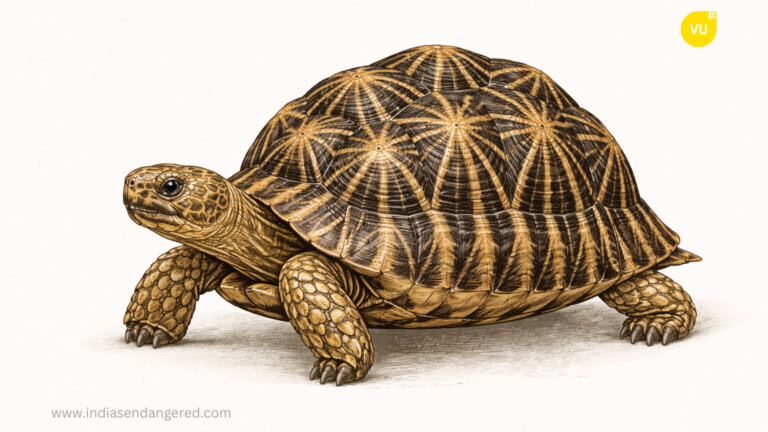
Indian Star Tortoise is species handpicked for Week 2 of our 2026 series 52 Weeks. 52 Threatened Species. To read about the project and other species visit The Jar
Ancient folklore says, the patterns on the carapace of the Indian Star Tortoise are celestial maps that help connect the earth with the heaven. There is also the story of Lord Vishnu’s Kurmavatar when during Samudra Manthan he took the form of a giant tortoise to support an entire mountain on his back to help in the churning of the ocean.
But this is not the story of a god-like creature to be revered or worshipped from behind glass. In the natural world, where nature has made calculated moves to give each creature enough tools to survive in the wild, the Indian Star Tortoise is a mathematical masterpiece. Its beauty is functional, its shape is geometrical, and its habits are a testament to the grit required to thrive in the scrub forests and arid grasslands of South Asia.
Here, we take a look at how nature combined art with physics to make this beautiful specimen of the biological world.
The Physics of the “Self-Righting” Shell
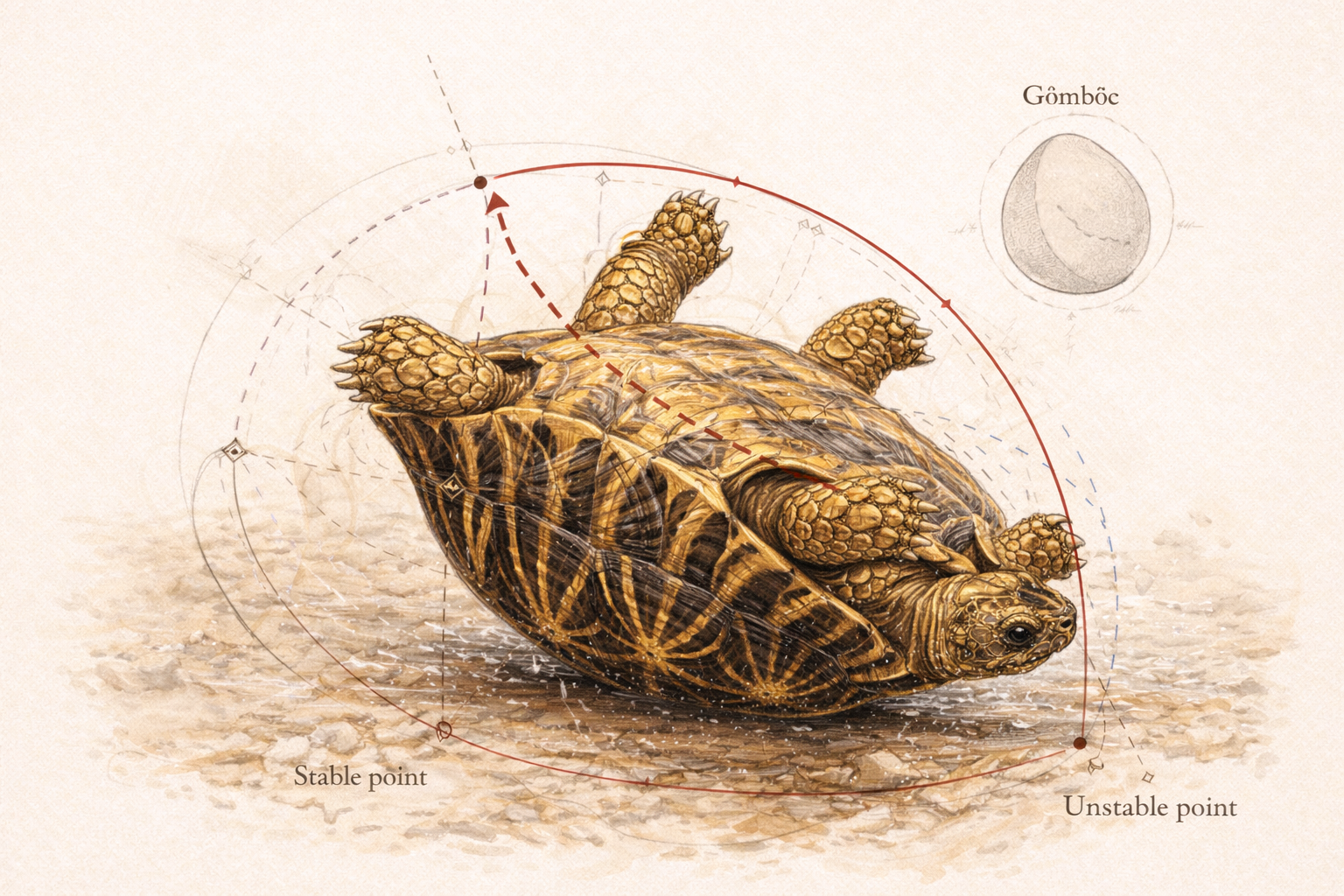
To understand the shell of this tortoise, you first have to understand a shape called a Gömböc. For centuries, mathematicians wondered if it was possible to create a solid object that had only one stable balance point. No matter how you roll it, it would always, automatically, return to the same upright position—just like those “weeble-wobble” toys that don’t fall down.
In 2006, mathematicians finally proved this shape existed, but the Indian Star Tortoise had already been using the design for millions of years.
The Star Tortoise’s shell is exceptionally high-domed and steep. It isn’t just “round”; it is specifically engineered so that its centre of gravity is very low compared to the height of its shell. When the tortoise is upside down, the highest point of its dome becomes a “point of instability.” Because the shell is so steep and curved, it is physically impossible for the tortoise to stay balanced on its back. Thanks to gravity, even a small wiggle of the tortoise’s neck or legs creates enough momentum to make the shell roll.
Why this matters? A tortoise stuck upside down is easy prey for predators like jackal or may get dehydrated easily. In the scrub forests where they live in India, Pakistan and Sri Lanka, such situations can easily become life-threatening. By flipping back up in minutes, the Indian star tortoise save energy and protect themselves from a vulnerable position.
The Stars are for Invisibility
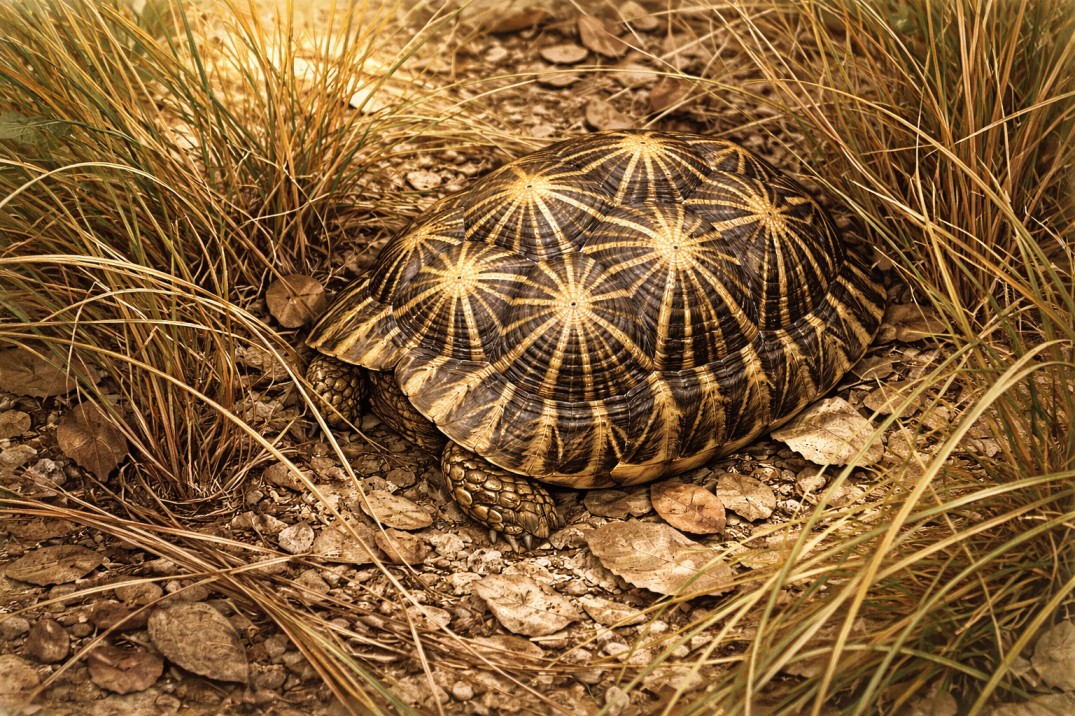
When you see the radiating rays on the tortoise’s shell, what does it remind you of? On a clean floor in your home those bright yellow rays on a dark brown background will clearly make the tortoise stand out. But this changes in the wild. These patterns were designed by nature to make it disappear.
The star pattern is a classic example of disruptive coloration. Most predators identify their prey by looking for a familiar shape—the curved outline of a shell or the shadow of a body. The yellow lines radiating from the center of each “scute” (the plates on the shell) do something clever: they break up the solid outline of the tortoise. To a predator’s eye, the sharp yellow lines “slice” the tortoise into smaller, unrecognisable shapes that don’t look like an animal at all.
The star also help in the tortoise’s natural habitat. The tortoise lives in dry grasslands and thorn forests. This environment is filled with tall, yellowing grass, fallen twigs, and patches of bright sunlight mixed with dark shadows. The yellow rays on the shell perfectly mimic these blades of dry grass, while the dark gaps look like the shadows in between.
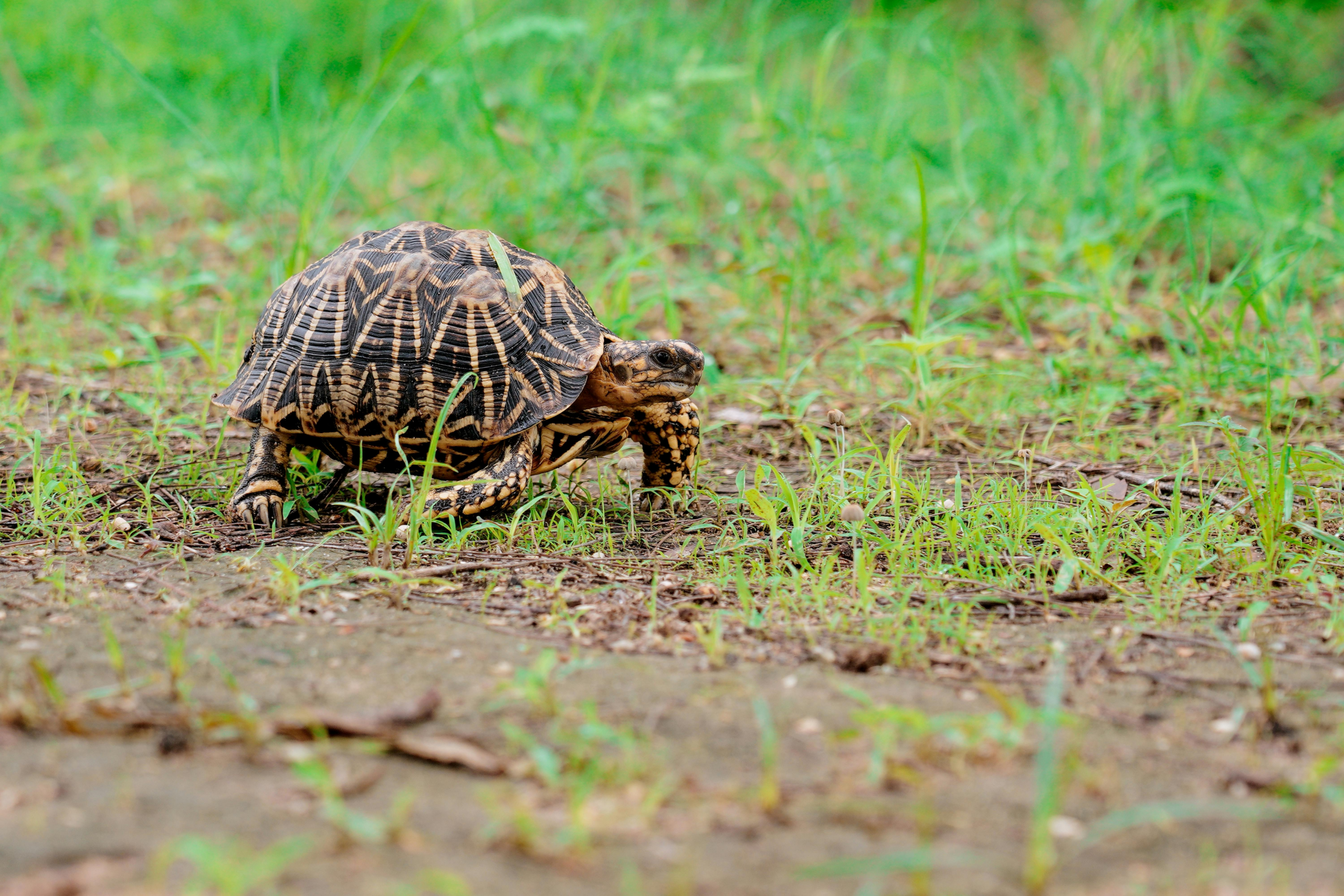
The most stunning effectiveness of the star or radiating ray pattern on the tortoise’s back is the reaction to dappled light. When the sun filters through the leaves of a bush, it creates a “noisy” pattern of light and dark spots on the ground. When a Star Tortoise retreats under a bush during the heat of the day, its shell pattern merges with this flickering light. Because the “stars” match the intensity and direction of the sunlight hitting the forest floor, the tortoise becomes a “ghost.” A predator could walk just inches away and mistake the tortoise for a pile of dry leaf litter or a patch of sun-scorched grass.
This camouflage is most effective when the tortoise is still. Unlike animals that rely on speed to escape, the Indian Star Tortoise relies on optical illusion. By tucking its head and legs in, it transforms from a living creature into a static, geometric object that simply blends into the background of the Indian scrub.
The very pattern that makes it so prized among human collectors helps the tortoise survive in the wild by remaining invisible.
Outsmarting the Predator’s Grip
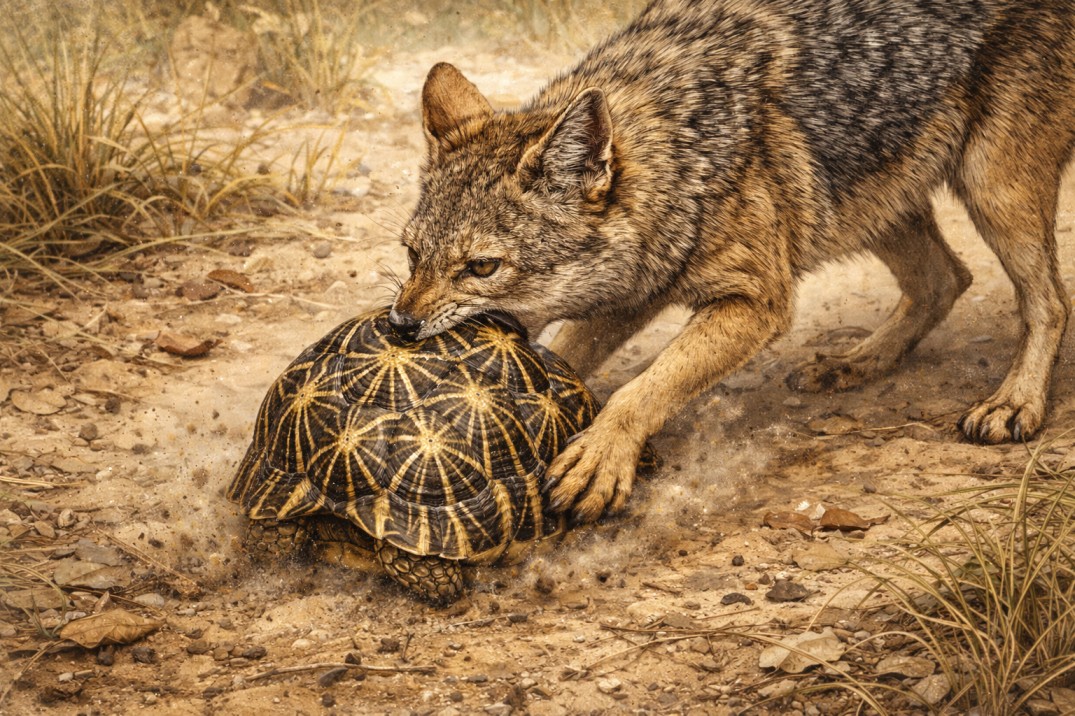
In the wild, the Indian Star Tortoise faces formidable hunters, most notably the Indian Jackal and various large birds of prey. These predators rely on the strength of their jaws to apply crushing pressure. Nature’s counter-move was to make the tortoise physically “un-grippable.”
Every predator has a limit to how wide it can open its mouth—this is called the gape. To crack a shell, a jackal needs to get its upper and lower teeth around the widest part of the tortoise to gain leverage. Most tortoises have somewhat flattened shells, but the Indian Star Tortoise has an exceptionally high, “tented” dome. Because the sides of the shell are so steep and the surface is so smooth, a predator’s teeth simply cannot find a flat surface to bite down on. As the jackal tries to bite, its jaws slide off the steep, curved sides of the dome.
If a predator does manage to get a partial grip, the geometry of the dome works like an architectural arch.
Just like the arches used in ancient stone bridges, the high dome of the shell distributes the pressure of a bite across the entire structure rather than letting it focus on one spot.
This “vaulted” shape is naturally much stronger than a flat surface. It can withstand significantly more pressure before cracking, often frustrating the predator until it gives up and looks for easier prey.

The high dome provides an internal advantage as well. It creates a massive amount of internal headspace. When the tortoise senses danger, it doesn’t just pull its head and legs in; it pulls them deep into the cavernous “attic” of the shell.
Because the dome is so high, the tortoise can tuck its limbs far away from the openings. Even if a jackal nibbles at the edges of the shell (the marginal scutes), it can’t reach the vulnerable flesh hidden deep inside the high-roofed fortress.
Nature’s Rain Dancers
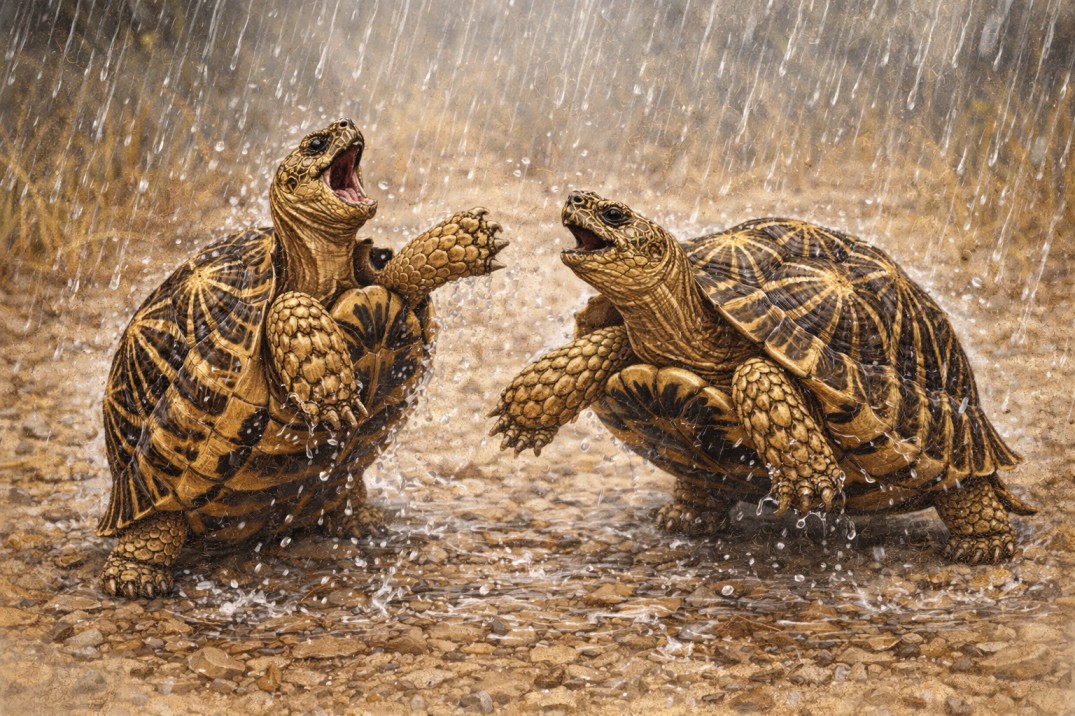
For an Indian Star Tortoise, the dry season is a time of grueling survival. They spend months in a state of semi-dormancy, hiding under dense bushes to escape the dehydrating heat of the Indian summer. But when the first dark clouds of the monsoon gather, everything changes.
The arrival of the first heavy rains triggers a behavioral shift that biologists often refer to as a “dance.” While tortoises are usually slow and cautious, the rain makes them move with sudden, vigorous energy. As the droplets hit their shells, wild tortoises have been seen extending their necks to the full length, swaying their bodies, and walking with a purpose they don’t show at any other time of year. They often “tiptoe” by stretching their back legs high, tilting their shells forward. This isn’t just for fun—it’s a calculated move to let the water run down the grooves of their shell toward their head so they can drink.
This is often the time they are most social. The rain brings them out from their hiding spots, leading to chance encounters and the start of the breeding season.
The monsoon dance is actually a biological necessity. After months of surviving the scorching heat, dust and grass litter gathers on the body of the tortoise. The rain washes away months of accumulated dust and parasites from their shells. More importantly, they drink deeply to flush out their systems and rehydrate their internal organs after the long drought.
Rain brings fresh food. It quickly transforms the parched brown earth into a lush green carpet. This “dance” is the tortoise’s way of racing to find the freshest, most nutrient-dense sprouts and succulents that only appear for a few weeks a year.
Here is the saddest part – the rain dance of the tortoise is never seen in captivity. In the tank or an artificial environment created to keep the tortoise, the temperature is always maintained, the ambience is static and there are no seasonal changes. Water comes in a bowl. When we take the tortoise out of its natural environment we take away the ‘music’ that they dance to.
Females Rule the Size Chart
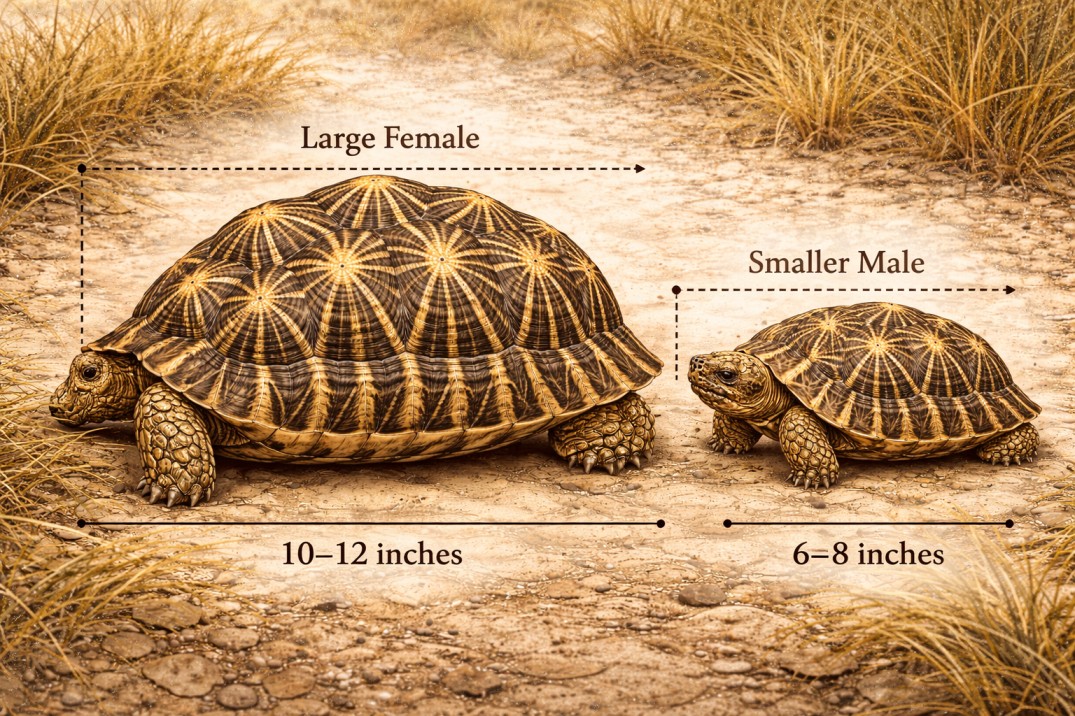
If you were to see a breeding pair of Indian Star Tortoises in the wild, the difference would be striking. While the males are compact and agile, the females can grow to be nearly twice the size and weight of their male counterparts. This isn’t an accident of nature; it is a calculated evolutionary trade-off.
The most practical reason for a female’s larger size is internal space. A female Indian Star Tortoise needs to carry and protect a clutch of eggs. The extra volume inside the shell is essential to provide enough room for the eggs to develop without putting dangerous pressure on her own internal organs.
Larger bodies can also store more fat and water. For a mother tortoise living in an environment where food might vanish for months, having a larger “fuel tank” ensures she has the energy to produce healthy eggs even during a harsh dry spell.
The males are smaller for another purpose. It helps increase their mobility. In the vast, scrubby terrain of South Asia, females are spread far apart. Males must travel long distances to find them, and being smaller makes it easier for them to pass through the scrubby forests and grass.
The High-Stakes Mating Wrestle
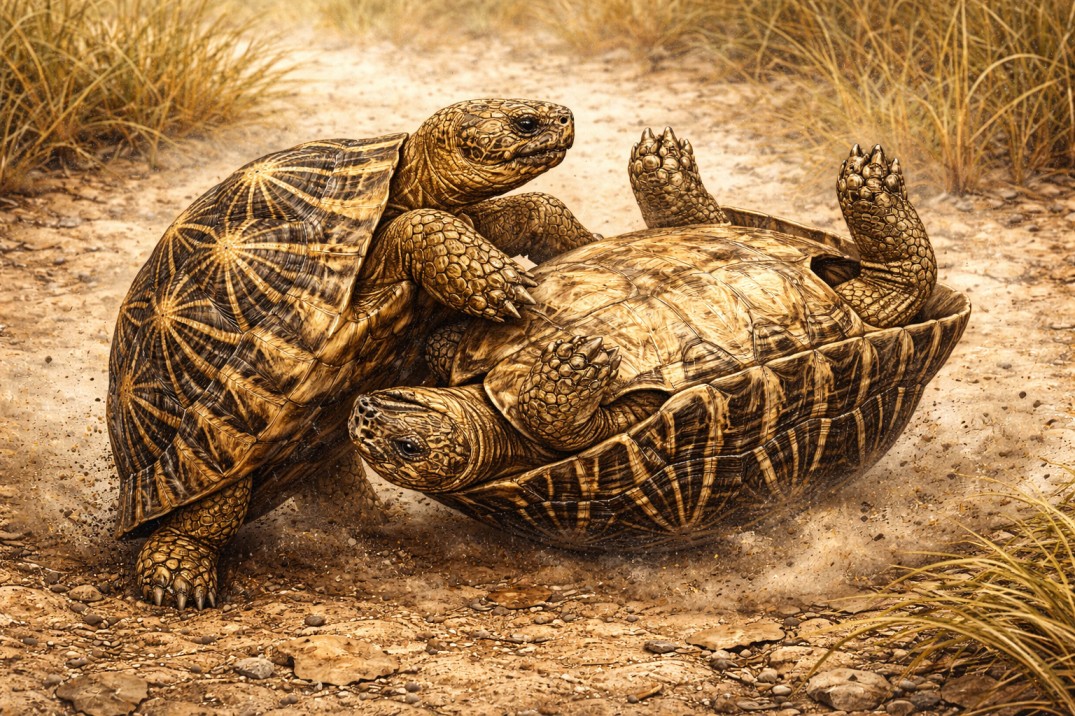
We would assume that the tortoise, being small and slow moving animals would be docile in nature. But the males are actually fierce, determined gladiators. When a female is nearby, the “celestial maps” on their shells become battle armour.
If you look closely at the front of a male’s bottom shell (the plastron), you’ll notice a thick, protruding “chin” of bone called the gular scute. This is his primary weapon.
- The males face off like miniature sumo wrestlers.
- They use this bony protrusion to ram into the side or the soft leg-opening of their opponent. The goal is simple: find a gap, get the “chin” underneath the other male, and lift.

Because we know the Star Tortoise shell is a Gömböc (designed to be unstable when upside down), the fight becomes a strategic game of tipping.
- The attacking male uses his front legs to gain traction and shoves with all his might.
- He is trying to force his opponent’s center of gravity past the “tipping point.”
- The defending male will tuck his head in and try to “anchor” himself to the ground, using his weight to stay level.
The “wrestle” can last for a long time, with both tortoises huffing and hissing (the sound of air being forced out of their lungs as they strain). If one male manages to flip the other onto his back, the battle is effectively over. The loser is now stuck in his “unstable” position. While his Gömböc-shaped shell will eventually help him roll back over, it takes time and immense effort. By the time the flipped male has righted himself, he is usually exhausted and disoriented. The victor has already claimed the territory and the attention of the female.
In the quiet of the dry forest, the sound of two shells colliding—clack, clack, clack—is the unmistakable signal that the “Stars” are fighting for their legacy.
The Survivalist’s Menu
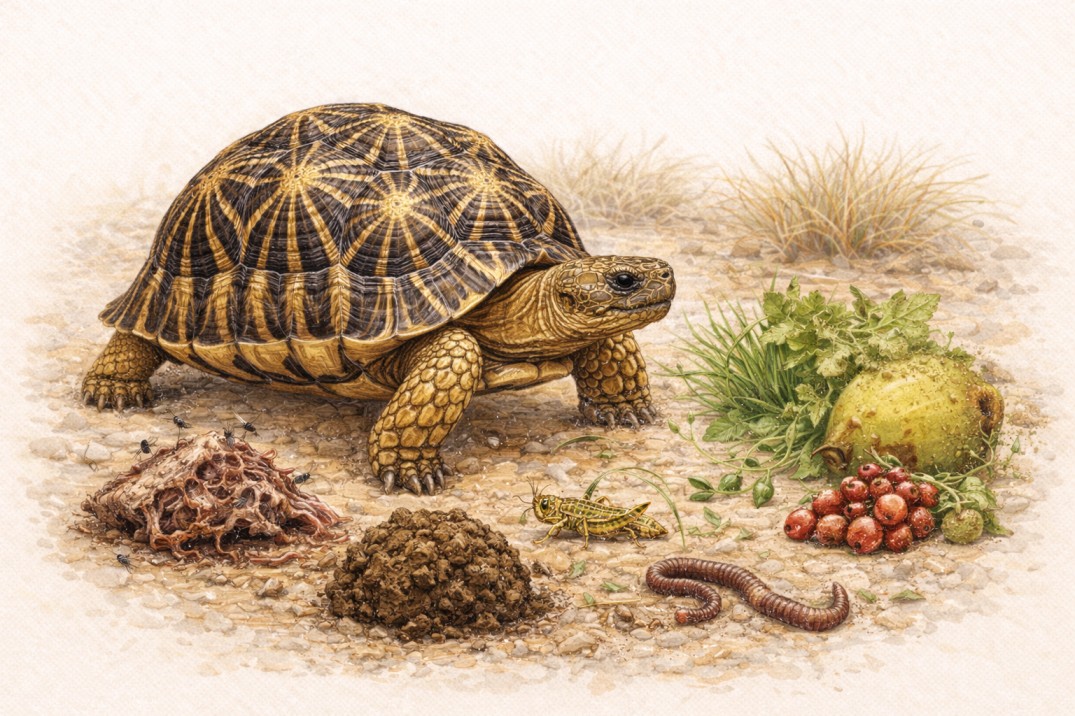
To survive in the arid scrublands of India and Sri Lanka, the Indian Star Tortoise has evolved to be the ultimate opportunist. Its diet is a fascinating example of how nature balances nutrition with a harsh, unpredictable environment.
While many people view tortoises as gentle herbivores that slowly munch on grass, the reality of the Indian Star Tortoise is far more “gritty.” Because they live in places where green grass can vanish for months at a time, their bodies are designed to extract life-sustaining minerals from the most unlikely sources.
The core of their diet is tough, fibrous greens. Unlike mammals, tortoises have a very slow digestive system that acts like a fermentation tank. This allows them to break down cellulose—the “unbreakable” part of dry grasses—that other animals would find useless. This high-fiber intake is crucial for keeping their gut healthy and preventing their “celestial” shell from growing too fast or becoming deformed.
Perhaps the most “marvelous” part of their diet is their role as a scavenger. To build and maintain a thick, bony carapace, a tortoise needs a massive amount of calcium. In the wild, they can’t get enough of this from plants alone. It is not uncommon to see a wild Star Tortoise gnawing on an old bleached bone or a discarded snail shell to “theft” the calcium for its own armour. Occasionally, they will eat insects or even scavenge on carrion (dead animals). This provides a rare but vital boost of protein and minerals that helps them through the breeding season.
When they find fleshy plants like succulents or fallen fruits, they eat greedily. These plants act like living canteens, storing water that the tortoise can hold in its system for weeks. Their metabolism is so efficient that they can go long periods without a single drop of standing water, relying entirely on the moisture locked inside their food.
In the wild, these tortoises are also known to eat animal dung. While this sounds unappealing to us, it is a survival masterstroke. The dung of herbivores contains pre-digested nutrients and healthy gut bacteria that help the tortoise maintain its own internal “lab” for breaking down tough desert plants.
The Indian Star Tortoise is so much more than a lucky charm.
It is a being shaped by millions of years of Indian sun, wind, and rain. Every line on its shell is a record of survival in the scrub. When we revere the Kurmavatar, we should remember that true reverence is about respecting the design of the creator.
To take this animal out of its landscape and put it in a box is to strip the “Star” of its sky. It is to take a high-performance survival machine and turn it into a stationary ornament. The Indian Star Tortoise doesn’t need our worship or our cages; it needs its freedom to walk the ancient paths of the wild.
Species at a Glance: Indian Star Tortoise
- Scientific name: Geochelone elegans
- Local name: Taara Kachhua (Hindi), Nakshatra Aamai (Tamil), Chukkala Thaabelu (Telugu)
- IUCN Status: Vulnerable (IUCN Red List) Population is declining rapidly due to illegal trade
- Population (India): Unknown exact numbers, but once considered common, they are now disappearing from many areas; the species is currently the most trafficked tortoise in the world.
- Range (India): Found in three distinct pockets: North-western India (Gujarat, Rajasthan), Southern India (Tamil Nadu, Andhra Pradesh, Karnataka), and parts of Odisha. Also found in Sri Lanka and Pakistan.
- Habitat: Dry scrub forests, semi-arid grasslands, and thorny deciduous woodlands; they prefer “edge” habitats where they can move between sun and shade.
- Major Threats: Illegal wildlife trade (pet market), habitat destruction for agriculture, and road kills during the monsoon when they are most active.
- Conservation (India): Schedule I of the Wildlife (Protection) Act, 1972 (this gives them the highest level of legal protection in India, same as the Tiger); CITES Appendix I (International trade is strictly prohibited).