The easiest way to collect an elephant’s DNA is through its dung. Elephants defecate frequently—about 12 to 15 times a day, often in large quantities—and sometimes even in sync with others in the herd, making it possible to gather multiple samples at once. The method is also non-intrusive, requiring no direct contact with the animal.
For the first time in India, scientists have used these dung samples to carry out a DNA-based count of wild elephants. The study revealed a population of 22,446 elephants, about 18% lower than the 2017 census figure. Officials say the new method likely provides a more accurate estimate than earlier visual counts, but conservationists warn the decline may also reflect the growing pressures elephants face from shrinking habitats, fragmentation, and conflict with humans.
The nationwide survey, which began in 2021, was conducted jointly by the Ministry of Environment, Project Elephant, and the Wildlife Institute of India. Researchers collected 21,056 dung samples from elephant landscapes across the country and used DNA fingerprinting to identify individual animals and estimate the total population.
The long-awaited report, released on October 14, 2025, places India’s elephant population between 18,225 and 26,645, with an average estimate of 22,446—significantly lower than the 2017 figure of 27,312.
Counting Elephants in Different Ways
Elephants are India’s pride. They are iconic, threatened and deeply entangled with the country’s landscape and its people. Protecting them is a moral, ecological and cultural imperative. Yet counting elephants is surprisingly hard.
In the 2017 elephant census, a combination of direct count, waterhole count, and indirect dung count methods was used across India. The direct count involved the team walking through designated sample blocks to visually observe and count the elephants. The waterhole count method involved observing elephants at watering holes to gather data on age and sex distribution. The indirect dung count estimated elephant density based on the number and decay rate of dung piles found along pre-defined transect lines.
The issue with these traditional survey methods was the higher chance of human error, double counting or missing an elephant here and there simply because they were not seen in the dense jungles and treacherous terrains.
In contrast, the DNA based count relied on unique genetic analysis. It is like counting people by their fingerprints left behind, rather than by glimpsing them in a crowd.
The new method adopted by the census team involved three-phase processes – ground survey, satellite-based mapping and genetic analysis. The total field effort covered nearly 6.7 lakh km of forest trails and included over 3.1 lakh dung plots.
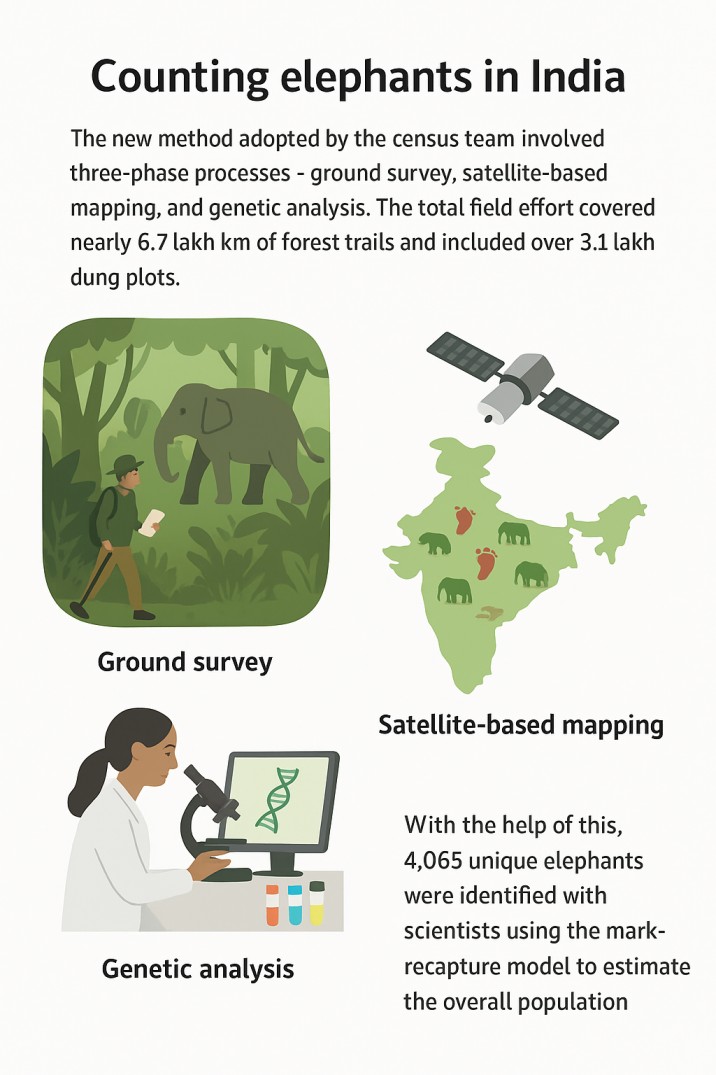
Ground surveys were like traditional methods where foot soldiers traversed through the jungle terrains to visually count the elephants. In the satellite-based mapping phase the habitats and the human footprints were observed. In the third phase the dung samples were collected and DNA mapping done. With the help of this, 4,065 unique elephants were identified with scientists using the mark-recapture model to estimate the overall population.
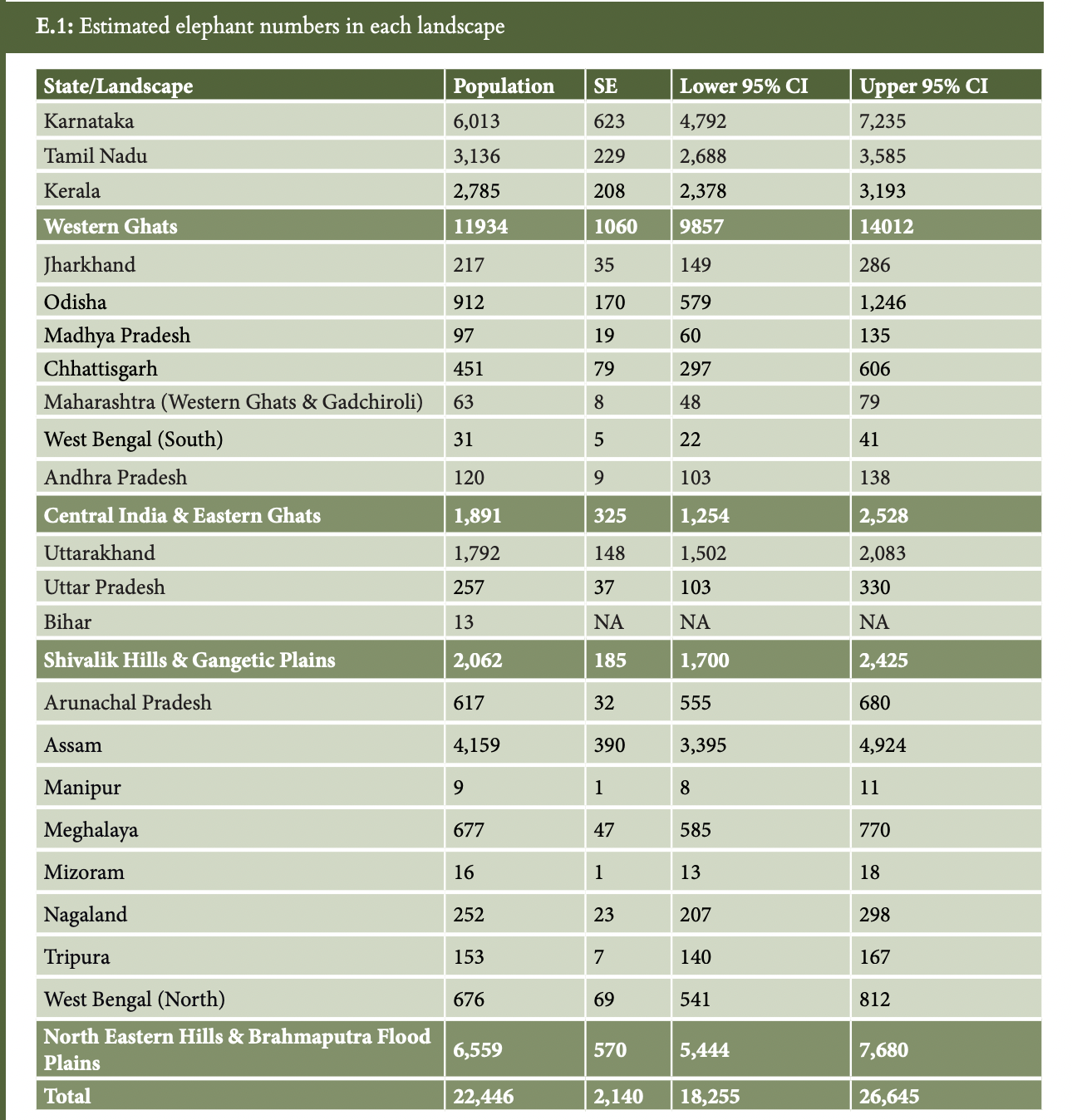
The report had the following findings of state wise and landscape wise elephant population in India, with Karnataka having the highest number of elephants,
What is the mark-recapture method?
To estimate elephant numbers, scientists used what is known as the mark–recapture method, a common technique in wildlife studies. Instead of physically tagging animals, they collected dung samples and used the unique DNA in each sample as a natural “mark.” When DNA from a later sample matched an earlier one, it counted as a “recapture.” ie. an elephant they had marked earlier was observed again. By comparing how many samples were new versus repeated, researchers could calculate how many elephants were likely present in the entire population — even those they didn’t directly sample.
More Than Just Numbers
The drop from 27,312 in 2017 to 22,446, is as the environment ministry puts it, a matter of re-calibration and not a reflection of failed conservation. But from a numbers standpoint, it is discomforting. What once looked like a stable population may actually have a much steeper drop when measured more precisely. Imagine you thought there were 100 elephants in a park, but by genetic tagging you realize only 82 distinct individuals show up — that’s a huge discrepancy.
Elephants are ecosystem engineers. From the Western Ghats of Kerala, Tamil Nadu, Karnataka, to the beautiful forests of Assam, Odisha and Jharkhand, it is the responsibility of these gentle giants to chisel forests by walking particular paths, disperse seeds miles and miles away from their parent tree, channel water and shape old and new habitats for all the residents of the jungle.
The decline likely signals that our earlier conservation successes with regards to elephants might be overestimated. Numerous studies in the past have shown that the jumbos of our forests are facing insurmountable pressures.
Farmlands and tea plantations have cut across crucial elephant corridors breaking a continuous forest land to pockets and making it that much more difficult for a herd to move. Practices like hula where people throw burning torches on elephants to dissuade them from entering farms is doing more harm than good, increasing wild elephant-human conflicts.
In the last decade, between 2019 and 2024, there were at least 81 elephant deaths in India due to train collisions, according to official data.
India still may be home to more than 60% of the Asian elephant population in the world but their habitats continue to shrink. If anything, the precision of this census provides a firmer baseline for future monitoring, corridor planning, and conservation interventions.
Read the complete report here – All-India Synchronous Elephant Estimation (SAIEE) 2025


4 thoughts on “India Has Fewer Elephants than We Thought, Finds First DNA Survey”