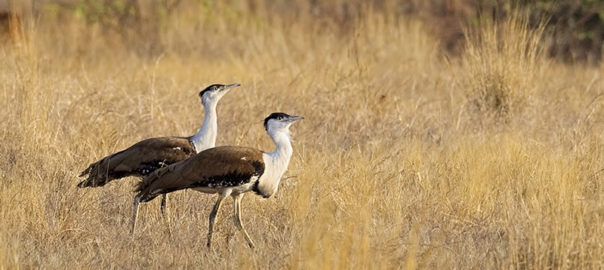
A stunning reel from Desert National Park, Rajasthan, recently circulated on social media, showing ten Great Indian Bustards (Ardeotis nigriceps) in a single frame — a remarkable sight for one of the world’s rarest birds.
According to Adesh Shivkar, who uploaded the video, there was a larger group numbered 16 bustards. For a critically endangered bird with an estimated global population of barely around 150 individuals, moments like these are extraordinary and worth pausing over.
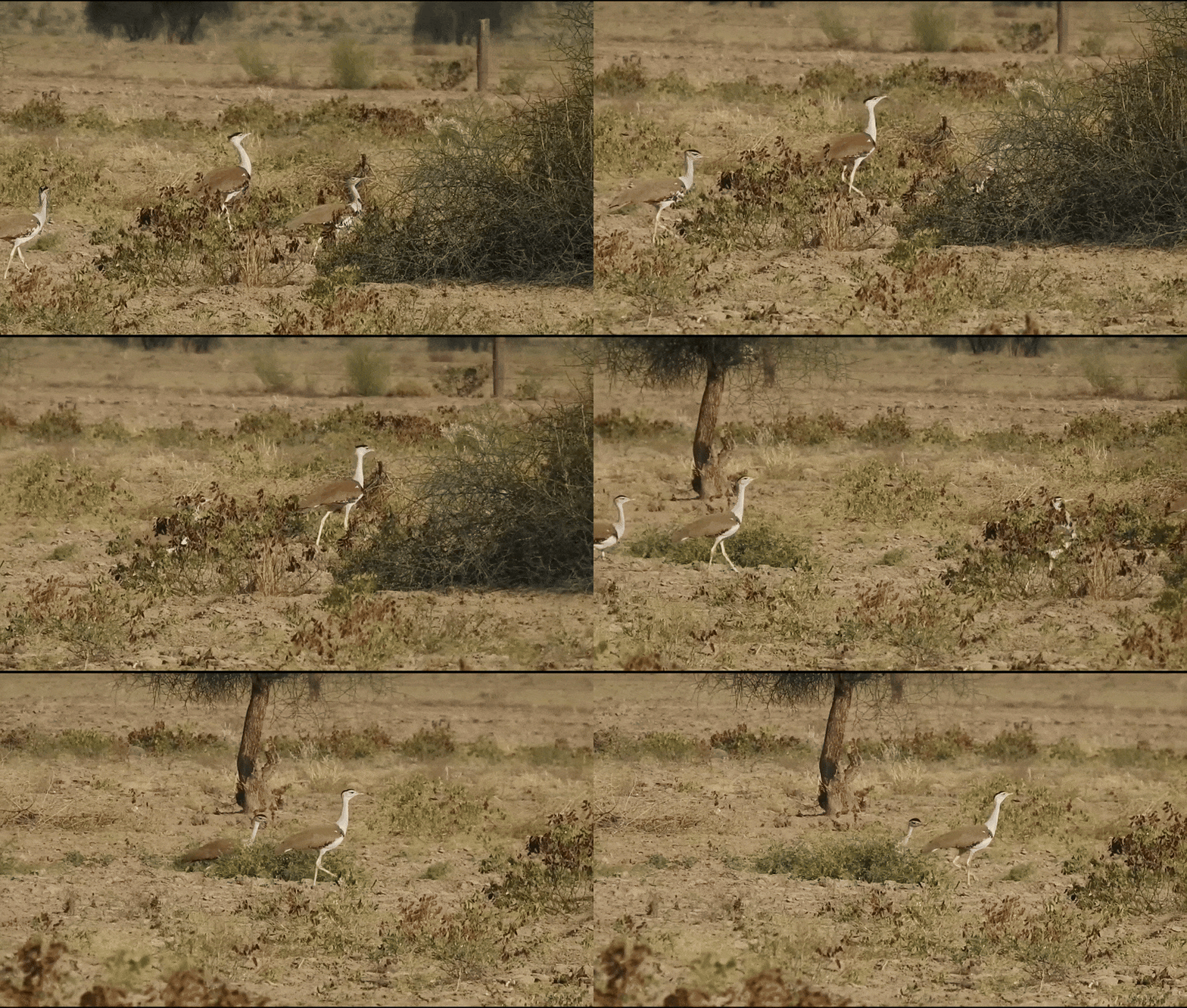
Shivkar wrote with his post, “We were blessed to witness 16 Great Indian Bustards (Ardeotis nigriceps) in the wild and even capture a video with 10 of them together in one frame . For a bird whose global population is estimated at barely ~150 individuals today , such a sight feels like witnessing history.”
Watch the video on Instagram,
This video isn’t just a beautiful moment captured in the wild; it also comes at a time when the Great Indian Bustard (GIB) is at the centre of intense conservation focus — including recent Supreme Court orders in India aimed at reducing a major threat to the species.
Read More: Great Indian Bustard numbers Rising in Rajasthan
A Legal Shield for the Skies: The 2025 Supreme Court Verdict
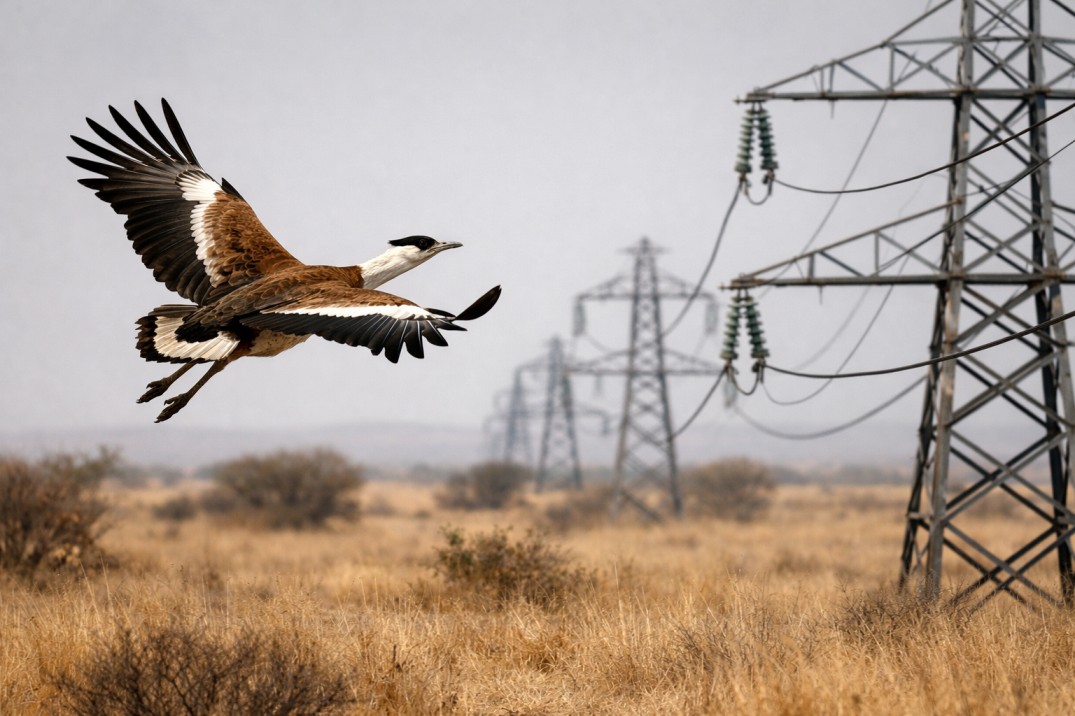
In December 2025, the Supreme Court of India delivered a final, landmark judgment in the case of M.K. Ranjitsinh & Ors. v. Union of India. This ruling is a “middle path” designed to resolve the long-standing conflict between India’s green energy goals and the survival of the Great Indian Bustard.
The key takeaways from the court ruling are,
Revised Conservation Zones:
The Court established a strictly protected “Revised Priority Area” updated mapping of key bustard habitats. In Rajasthan, this revised priority area covers 14,013 square kilometres, while in Gujarat it spans 740 square kilometres.
These priority zones now serve as the core landscapes where conservation measures (including power line mitigation) must be focused. Recognising such zones legally is significant because it anchors future planning and development decisions in known bustard presence, rather than ad hoc or poorly mapped territories.
A “No-Go” for Big Energy:
Within these priority areas, the Court has banned the installation of new wind turbines and solar plants with a capacity exceeding 2 MW unless they comply with mitigation criteria. This represents a rare instance of the law slowing the march of infrastructure explicitly to safeguard an endangered species.
The Power Line Compromise:
While a blanket ban on all overhead lines was deemed technically unfeasible in 2021, the new 2025 order mandates that:
- 80 km of 33 kV lines in Rajasthan must be moved underground immediately.
- Any high-voltage lines that must exist must be consolidated into specific, narrow “power corridors” located at least 5 km away from the Desert National Park boundaries.
- All mitigation work, including rerouting and burying lines, must be completed by 2028.
The court has made it clear “Corporate Social Responsibility” now officially includes “Environmental Responsibility.” Companies operating in these desert landscapes are now legally and ethically bound to contribute to the recovery of the species they share the land with.
The Supreme Court of India said,
“Allocating funds for the protection of the environment is not a voluntary act of charity but a fulfillment of a constitutional obligation.”
This big win for the GIB is not for the species alone. The Great Indian Bustard is a “flagship” species for the grassland ecosystem. Often misclassified as “wastelands,” these grasslands are biodiversity hotspots. The GIB acts as a barometer: if the bustard is thriving, the entire ecosystem—from insects to soil health—is healthy.
Historical Range and Current Numbers of Great Indian Bustard
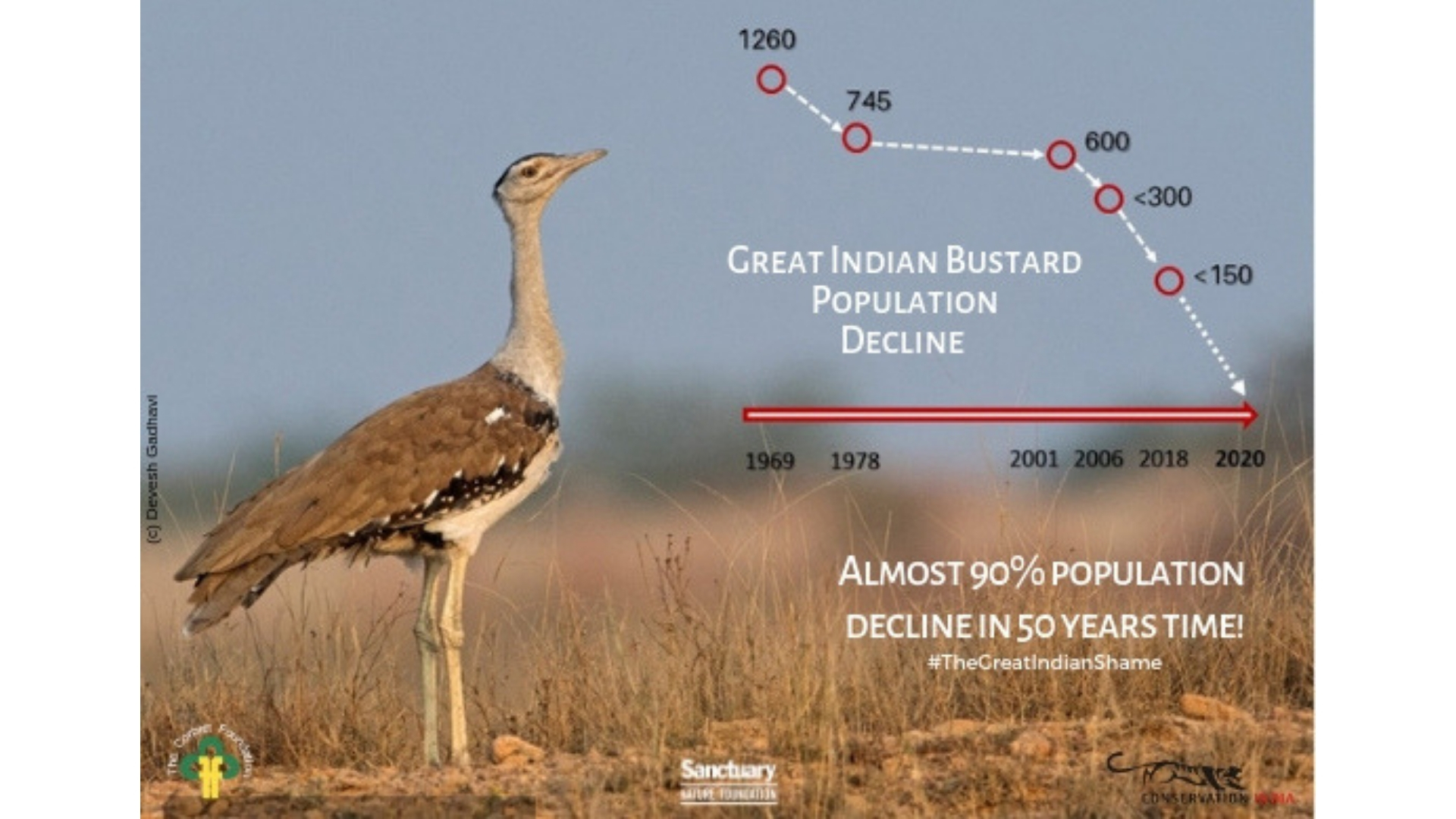
The Great Indian Bustard (Ardeotis nigriceps) was once widely distributed across the western and central grasslands of India, extending from the Thar Desert in Rajasthan southwards through the Deccan Plateau and into parts of central India. Its historical range included:
- Rajasthan
- Gujarat
- Maharashtra
- Karnataka
- Andhra Pradesh
- Madhya Pradesh
- Possibly fringes of Haryana, Punjab, and even Pakistan’s desert grasslands
The agricultural revolution came as a big blow to its population and led to the decline in numbers of the grassland species. The bustard also lays just one egg each season, making it incredibly hard for the population to recover rapidly. The presence of feral dogs that are after the eggs and the young chicks adds to the problem.
Sadly, bustards were last seen in Andhra Pradesh in 2019. In other states too, except Gujarat and Rajasthan, the sightings have been limited to one or two infrequent ones.
Currently Rajasthan has ~150 individuals, found mainly in and around Desert National Park (Jaisalmer) and adjacent dryland grasslands. Gujarat estimated <15 birds, occurs around Lala-Naliya Sanctuary and nearby grasslands in Kachchh, a remnant population showing evidence of range shrinkage.
Then how did this reel show 10 bustards at once?
This sighting is definitely rare but it is also evidence of something good happening in Rajasthan.
The Desert Fortress of Desert National Park
For decades, the Great Indian Bustard (locally known as the Godawan) struggled with habitat fragmentation. The Rajasthan Forest Department adopted the “landscape-first” strategy a few years ago to help the state bird.
Here is how Rajasthan turned the tide:
The Power of Enclosures:
The department has established over 28 specialised enclosures—predator-proof fenced areas where human entry and livestock grazing are strictly prohibited. These act as “nurseries” where the birds can nest on the ground without their eggs being trampled by cattle or eaten by feral dogs and foxes.
Grassland special meals:
The GIB is a picky eater. Rajasthan has focused on “Habitat Enrichment” by planting vast swathes of Sewan grass (Lasiurus sindicus), which provides the perfect cover for nesting and attracts the protein-rich beetles and grasshoppers the birds depend on.
Dummy egg strategy:
In a clever move for 2025-26, DNP teams began replacing wild eggs with identical “dummy eggs” in the desert. The real eggs are whisked away to a high-tech incubation center to ensure they hatch safely, and the healthy chicks are then integrated back into the landscape, significantly increasing the survival rate of the birds.
Community Guardians:
Rajasthan shifted the narrative by turning local villagers into “Bustard Guardians.” By providing incentives for reporting sightings and protection, the Forest Department has created a human shield around the birds.
The sight of ten Great Indian Bustards moving in unison across the Thar is more than just a viral moment; it is a visual manifesto of what is possible when law, science, and local communities align. As we move through 2026, the transition from “critically endangered” to “recovering” remains a steep climb, but the foundation has been laid. Between the Supreme Court’s legal shield for the skies and Rajasthan’s fortress on the ground, the Godawan is finally being given the room it needs to breathe.
Read More: Wanted, Eggs of the Great Indian Bustard
Species at a Glance: Great Indian Bustard
- Scientific name: Ardeotis nigriceps
- Local name: Godawan (Rajasthan and local Hindi usage)
- IUCN Status: Critically Endangered (IUCN Red List)
- Population (India): ~150 – 249 mature individuals remaining, extremely small and declining; core stronghold in the Thar Desert (Rajasthan, with small scattered individuals in Gujarat, Maharashtra, Karnataka)
- Range (India): Restricted to northwestern India’s grasslands, especially Rajasthan and parts of Gujarat; historically broader across the subcontinent but now largely extirpated from former range
- Habitat: Arid and semi-arid grasslands, scrublands, open plains with low vegetation — preferred for breeding and foraging
- Major Threats: Habitat loss and fragmentation, collisions with power lines, agricultural expansion, linear infrastructure, poaching and incidental mortality
- Conservation (India): Schedule I Wildlife (Protection) Act, 1972; CITES Appendix I; subject of national recovery programmes