It takes 22 months for an elephant calf to be born, and another 6-8 years of tender loving care within a matriarchal herd before it is ready to lead the life of an adult.
Walking in herds mostly made up of female elephants, the young learn essential skills like how to use their trunk, look for delicious edible food plants, and traverse jungle paths as they carry on the work of moulding forests for other species to survive.
A herd of hundreds of elephants is common in India, especially in forest areas that are marked as elephant habitats. This includes a large part of eastern and northeastern India (mostly West Bengal, Assam, Odisha); the Terai and valmiki landscape (largely Uttarakhand, Uttar Pradesh, Bihar, Jharkhand); and the Western Ghats (mostly Kerala, Karnataka, Tamil Nadu).
These elephants never stay in one place. They keep moving, looking for food and on a typical day might move three to fifteen km depending on the availability of fodder.
All of this is known elephant behaviour — the herd, the presence of young ones, the constant movement through ancient forest paths. And yet, elephants are dying. Because a railway track cuts through their forest.
Hit by a train because the driver pulled the brakes at the last moment.
Hit by a train because there was a miscommunication between the railway and the forest officials and the engine pilot did not know that there were elephants crossing the track.
Or hit by a train because it was dark and they were not visible in time.
Are the jumbos of the jungle not visible?
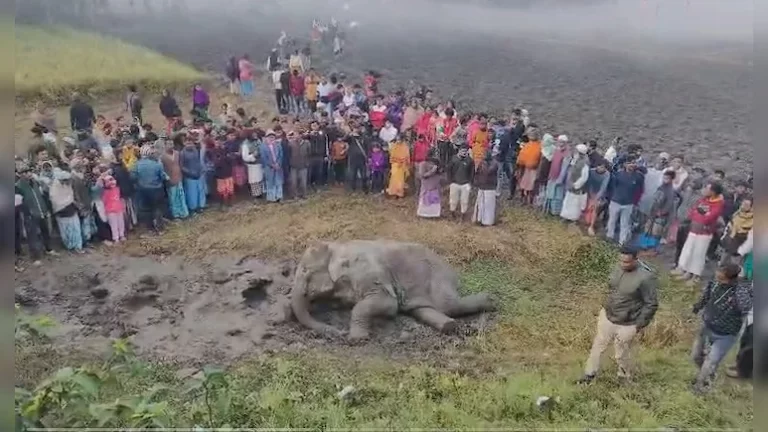
Eight On 20 December, 2025 a herd of elephants collided with the Sairang-New Delhi Rajdhani Express in Assam’s Hojai at around 2.17 am. Seven elephants including 3 adults and 4 calves died on the spot. Another calf was severely injured and died later at the rescue centre. A total of 8 lives were lost. The collision derailed five coaches but no passenger was hurt.
Two A month earlier, an elephant lost its life when hit by a train in West Bengal’s Jalpaiguri district. A calf was also found injured at the site. It is not known whether it survived.
One In September a female elephant was hit by a speeding Bhubaneswar-Dhanbad Special Express in Odisha leading to fatal injury. The incident occurred despite the Sunakhan locality being earmarked as an elephant movement zone.
Three An adult and two calves were hit by a train in West Bengal’s Kharagpur region in July.
One A tusker was killed after being hit by a speeding train on the railway track near Betanati Range in Mayurbhanj district, Odisha on 1 November.
One A 25-year-old male elephant was critically injured and died of its injury after being hit by a speeding OMS (Oscillation Monitoring System) special train which runs between Uttarakhand’s Gularbhoj and Lalkuan areas. The incident happened next to a board that warns drivers to lower train speed in the area because of elephant movements.
These are just the recorded incidents from 2025. There could be others where the news did not reach any media outlet.
With the 20th December tragedy, the number of elephants dying due to collisions with trains in India has risen to an estimated 95 in five years. Long-term data (1987-2023) reveals 355 elephant deaths in train collisions, with Assam and West Bengal accounting for the majority.
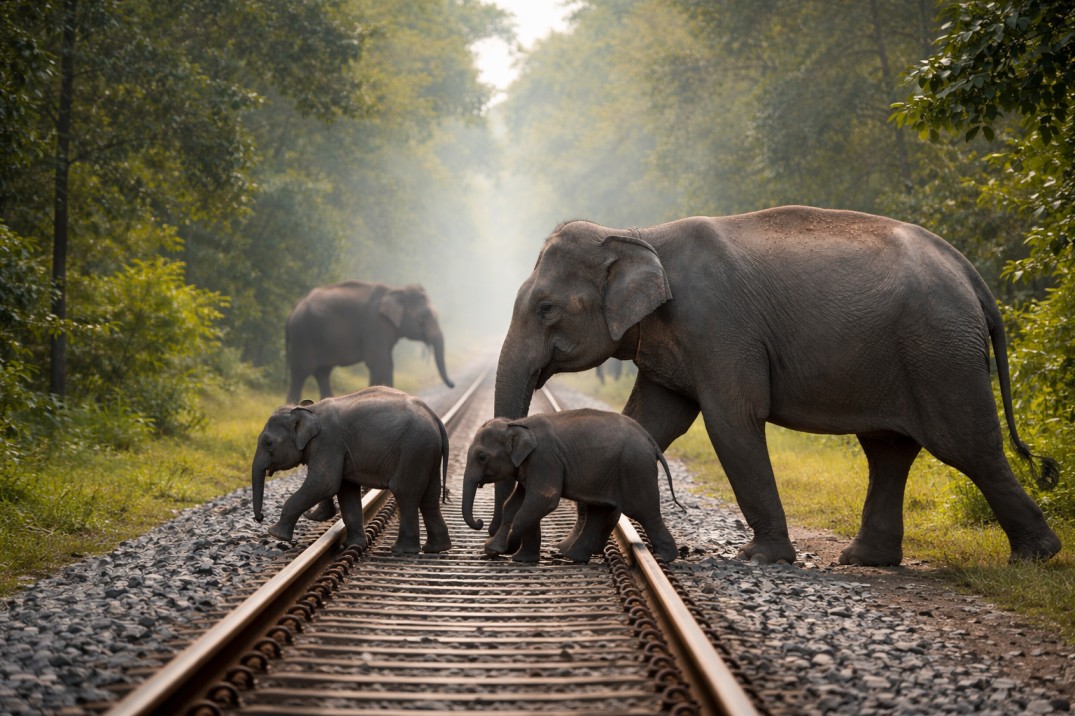
Deadly tracks, careless drivers or inadequate measures?
In the monsoon session of Parliament, the government informed that 81 elephants had been killed between 2019 and 2024 due to train collisions. It also stated that a comprehensive report titled “Suggested Measures to Mitigate Elephant and Other Wildlife Train Collisions on Vulnerable Railway Stretches in India” has been prepared after field surveys across 127 identified railway stretches spanning 3,452.4 km.
The report said 77 railway stretches in 14 states had been identified and prioritised for mitigation against elephant-train hits. There were also several mitigation measures that were suggested in this March 2025 report.
Even before this report, state governments and Indian Railways had planned measures to address elephant–train collisions. These include:
- Lowering the speed of the train on tracks within forest and known elephant corridors
- Thermal cameras and eco-friendly buzzers like bee-sounds
- Construction of underpass, vegetation clearance and fencing
- AI-powered intrusion detection systems (IDS) and sensors
- AI thermal camera systems
Some of these tech-enabled systems seem to have worked too. In Coimbatore’s Mudukkai forest range there have been zero elephant deaths due to train collisions thanks to the installation of the AI thermal cameras. The forest department had set up towers with AI cameras along the railway lines passing through the forest in November 2023, after 11 elephants were killed on the tracks from 2008 to 2022.
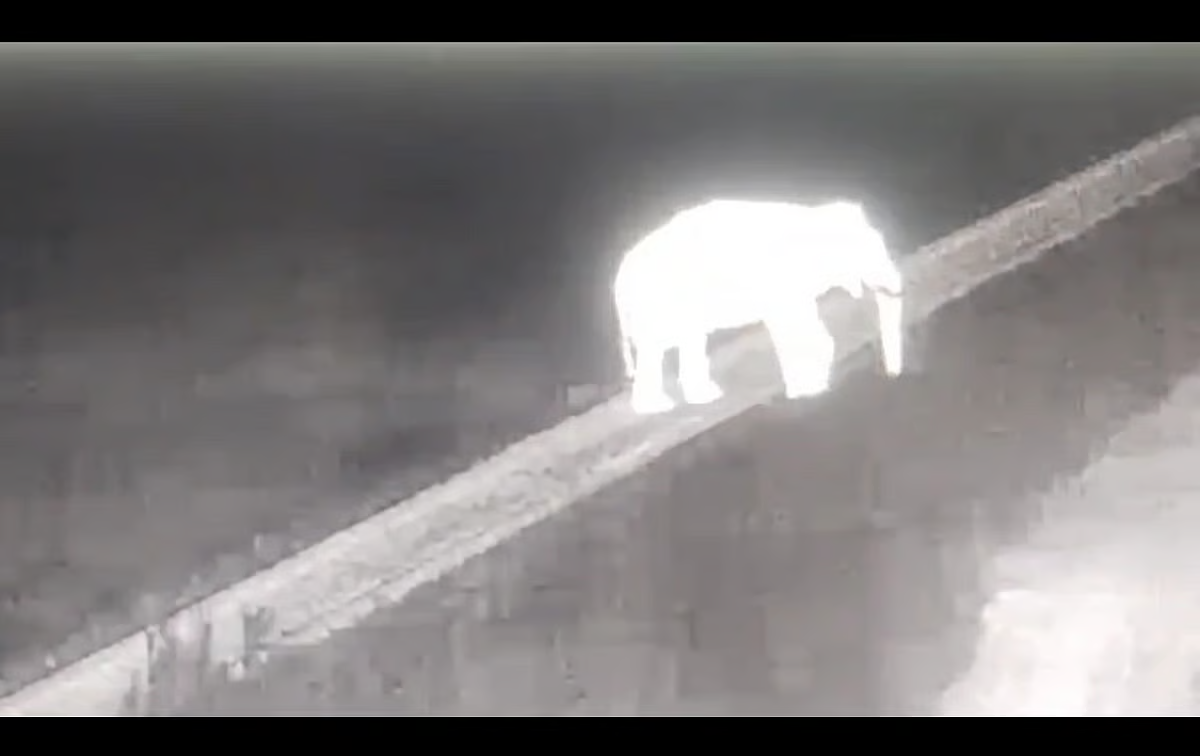
According to forest department data, wild elephants have crossed the A and B line tracks 2,659 times since then, with no elephant–train collisions reported during this period.
Even in regions which are not known elephant corridors, alert pair of eyes have helped evade tragedy. In Jharkhand this July an engine driver slowed down the train and halted it completely for two hours when he spotted an elephant mother near the track ready to deliver a baby. The train resumed only after the calf was born and both animals safely returned to the forest.
There may be other instances where the vigilance of forest guards, railway officials, and drivers prevented tragic outcomes. But a toll of nearly 100 elephants dying in five years simply because they were crossing railway tracks through their forests raises serious questions about the gap between policy on paper and reality on the ground.
Gaps, Miscommunication & Implementation Challenges
The spate of elephant-train tragedies across India, especially in West Bengal, Assam and Odisha highlight a broader system failure and cannot be deemed as isolated incidents.
As acknowledged by experts and government departments themselves, several issues persist:
- Coordination Gaps: Despite tech tools being available, forest departments and railways often lack coordinated monitoring and response, especially outside formal corridors.
- Resource & Coverage Limitations: IDS and AI systems are good to talk about but not yet widespread enough to cover most high-risk stretches.
- The most extensive rollout is under the Northeast Frontier Railway in Assam and North Bengal, where fibre-optic Distributed Acoustic Sensing (DAS)–based IDS has been installed across 11 elephant corridors covering over 140 route kilometres, with railway officials reporting a sharp decline in collisions on monitored stretches (LiveMint; Economic Times).
- In southern India, the Tamil Nadu Forest Department, in collaboration with Indian Railways, has deployed AI-enabled thermal and optical cameras along a critical 7-km Madukkarai–Walayar railway stretch, where authorities say no elephant deaths have occurred since the system became operational in early 2024 (Down To Earth).
- Pilot and approved IDS projects are underway in Odisha–Jharkhand under South Eastern Railway and in Uttarakhand’s Shivalik elephant landscape.
- The Railways’ national “Gajraj” initiative proposes extending AI detection across several hundred kilometres of high-risk elephant habitat.
Conservation experts caution, that most elephant–train fatalities still occur outside these protected stretches, pointing to gaps in spatial coverage, rather than a lack of technological solutions.
- Policy vs. Practice: Proposed infrastructure mitigation and sensor interventions remain partially planned or unfunded, while collision numbers continue to climb.
- Long-standing traditional solutions like “Plan Bee” (bee sound deterrents) showed limited effectiveness, exemplifying the complexity of the problem.
Tech will come tomorrow, what can be done today?
While AI-based intrusion detection systems and sensor-driven alerts are being piloted across parts of India’s railway network, their expansion across elephant landscapes will inevitably take time.
Conservation practitioners have long pointed out that elephant–train collisions can be reduced even in the absence of advanced technology, through measures that rely on coordination rather than hardware.
These are steps such as,
- Joint forest–railway patrolling on vulnerable stretches
- Better visibility management near curves and cuttings
- Clear signage to alert loco pilots
- Seasonal speed regulation
- Regular and active information-sharing on elephant movement
According to Wildlife Trust of India, Rajaji National Park in Uttarakhand, adopted similar recommendations two decades ago, and has recorded zero elephant deaths from train hits since 2002. This was after implementing patrols and other ground measures, showing that such approaches work when sustained and coordinated across agencies.
These actions involving forest and railway departments working alongside conservation NGOs, offer immediately deployable solutions that complement future technology and save lives now.
Another critical issue is collision data itself. Different sources — including central and state governments — report varying numbers. Collision data requires standardised institutional recording and transparent year-by-year tracking, similar to systems used for tiger monitoring.
Recommendations for the future
Drawing on expert opinions, field studies, and official reports, the following steps could help reduce elephant–train collisions.
Governance & Coordination
- Establish joint railway–forest command centers in all high-risk states for real-time response.
- Expand IDS, AI alerts, and integrated train-control communications with forest watchers.
Infrastructure
- Prioritize underpasses, overpasses, and dedicated wildlife bridges at historic crossing points.
- Mandate speed limits and automated warning systems in high-density elephant zones.
Monitoring & Data
- Implement nation-wide standardized reporting mechanisms for elephant–train incidents, including injuries, near misses, and mortality.
Community & Ecology
- Incorporate local ecological knowledge into corridor mapping and adaptive management.
Man-made hazards are everywhere for elephants. In Odisha alone 136 wild elephants died in 18 months (between April 2024 and September 2025), averaging more than seven deaths a month, from causes that include electrocution, disease, train collisions and poaching.
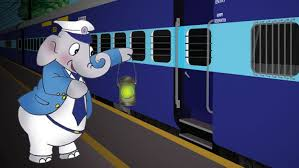
As India continues to expand its rail network, the irony is hard to miss: the official mascot of Indian Railways is Bholu, the elephant — a symbol meant to represent strength, memory, and reliability. Ensuring that real elephants can cross landscapes safely would be the most meaningful way to honour that symbol.
Species At a Glance: Asian Elephant
Scientific name: Elephas maximus
Common name: Hathi
IUCN Status: Endangered
Population: Approximately 22, 446 in India (as of All-India Synchronous Elephant Estimation (SAIEE) 2025)
Range: India, Sri Lanka, Nepal, Bhutan, Bangladesh, Myanmar, Thailand, Laos, Cambodia, Vietnam, Malaysia, Indonesia
Habitat: Tropical and subtropical forests, grasslands, scrub forests, and human-dominated landscapes
Major Threats: Habitat loss and fragmentation, human–elephant conflict, linear infrastructure (roads, railways, power lines), poaching, climate-related stress
Conservation Status in India: Protected under Schedule I of the Wildlife (Protection) Act, 1972; included in Project Elephant
Ecological Role: Keystone species that shapes forest structure and aids seed dispersal