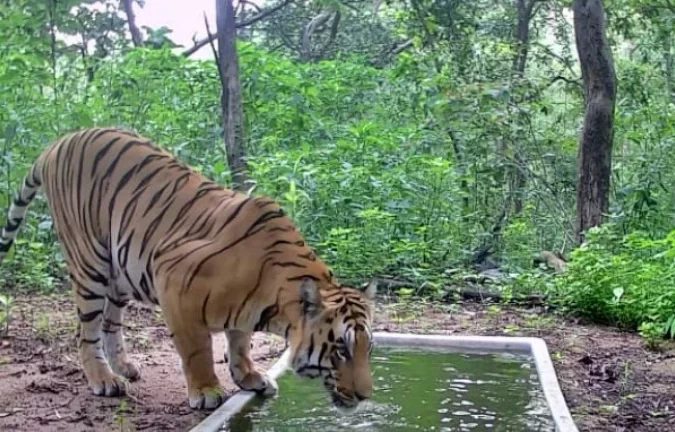
There is a tiger living alone in Gujarat since February 2025. Now, encouraged by its persistent presence in the state, the National Tiger Conservation Authority (NTCA) is planning to play matchmaker and shift two tigresses from Madhya Pradesh into the same forest. If the plan is executed, the lone tiger will have not one but two potential mates to choose from in the coming months.
A Tiger in Lion State of India
In February 2025, a male Bengal tiger was first photographed in Ratanmahal Wildlife Sanctuary, Dahod district, in Gujarat after more than 30 years without a confirmed resident tiger in the state. It is believed to have wandered in from neighbouring Madhya Pradesh.
While the exact age of this tiger is uncertain, it is believed to be four years old as per an October 2026 report. The tiger does not have a GPS collar therefore its movements in the forest are hard to track. Forest officers have been relying on camera trap images, pugmarks and field observations to understand its movements. Its reported range expanded to approximately 120 sq km by January 2026, including areas around Chhota Udepur and Devgadh Baria.
Read More: A Tiger from Ranthambore Has Moved to the Kuno National Park
Mates for the Lone Tiger
Now, encouraged by its continued presence the NTCA hopes to introduce two female tigresses into the forest. This proposal was given by a panel headed by H.S. Singh, a former member of National Board for Wildlife and its standing committee including noted wildlife scientists Dr. Bilal Habib and N.V. Kale, assistant inspector general of forest with NTCA.
The experts believe releasing two females in different parts of the known territory of the male tiger will increase the chances of a possible encounter and eventual breeding. One of the tigresses may be released in the Choota Udepur area and the other in Sagatala.
The proposal has been sent to the state government as well as the Union ministry of forest and environment. If it is approved, the translocation of the two female tigers from Madhya Pradesh might happen as early as December 2026.
Did Tigers Ever Live in Gujarat?
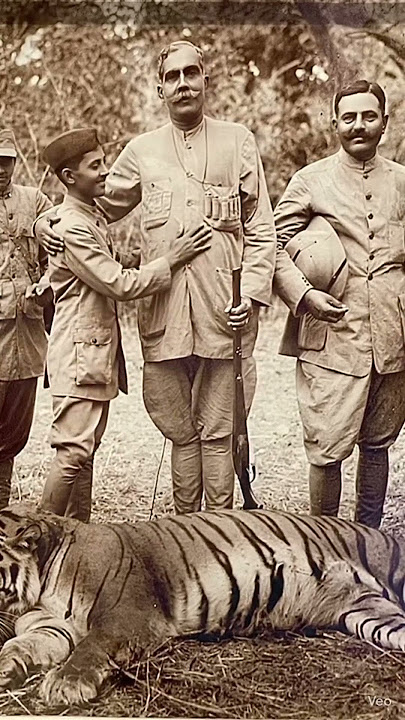
Historically, tigers lived in Gujarat across the state.
As Raza Kazmi writes here for an article for Wildlife Conservation Trust, “At the turn of the 20th century, Gujarat was the only place in the world where you could hope to see four big cats — lion, leopard, tiger, and cheetah. The first two still live in Gujarat. Unfortunately, the Asiatic cheetah (Acinonyx jubatus venaticus) faded away from the state by the late 1930s, when the last one was shot in Junagadh district in 1940.”
He further adds, “By the turn of the 20th century, even though Gujarat’s tiger numbers were a fraction of what they used to be in the 1850s, they were still common in the forests of Palanpur, Danta, Idar, and other smaller princely states in the north; the hilly tracts of Mahikantha and Rewakantha Agency in the east; and the mixed teak forests to the south, especially the Dangs. The interior districts of Surat, Baroda, and Bharuch also got an odd tiger here and there. As late as 1952, a man-eating tiger was shot in Bharuch district.”
Around the 1960s a senior forest official recorded more than 50 tigers in Gujarat but this was not an official count. In the first formal census of tigers in India in 1972, 8 tigers were counted from Dangs in Gujarat. Later the numbers began declining sharply owing mostly to hunting, and habitat fragmentation. In 1997 only one tiger was counted in Gujarat and in the 2001-2002 census, none were recorded. In February 2019 a tiger was photographed in Mahisagar district. It survived for only about 15 days before dying.
Historical accounts document tigers in several parts of the state:
- The Dangs: The last major stronghold in southern Gujarat, connected historically to forests in Maharashtra.
- Panchmahal and Rewakantha: Tigers were once numerous in the eastern forested districts.
- Palanpur, Danta and Idar: Historical records also describe tigers in northern Gujarat.
Read More: Wear a Mask Backwards to Save Yourself from a Tiger
A tiger’s survival in any new territory depends on a few things. Good prey base, a place to rest, stalk prey, good water sources and connected forest landscapes to expand territories or find new territories as their numbers grow.
Ratanmahal has plenty of wild boars and nilgai, dry teak forest, mixed deciduous woodland, bamboo brakes and hilly terrain. It is part of the Vindhya–Malwa region, which links several central Indian landscapes. The sanctuary has natural water sources and lies in the Panam River catchment.
All these factors make the landscape ideal for a tiger but a sustained tiger population will be possible if Gujarat and Madhya Pradesh continue to protect the connected forest landscape well enough for tigers to move through it, establish territories and breed.


