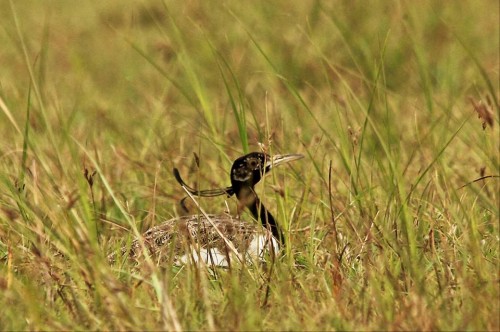
An extremely rare and critically endangered Spoon-Billed Sandpiper was recently spotted at Patibunia beach in West Bengal. Through a tag found on the bird’s leg, researchers were able to pinpoint its origin to be in Chukotka, Russia, from where the bird embarked on a nearly 8,000-kilometre-long journey to reach its destination in India. With fewer than 500 individuals remaining in the wild, every sighting of this tiny shorebird is greatly significant, especially in India, where the bird has rarely been recorded.

About the Spoon-Billed Sandpiper
The spoon-billed sandpiper (Calidris pygmaea) is a small migratory wading bird, which is instantly recognisable due to its spatula-shaped bill that is swept in a side-to-side manner while feeding. Breeding adults have reddish-brown heads, whereas non-breeding adults lack such striking colouration. They breed in the remote tundras of northeastern Russia, particularly along the Chukchi and Kamchatka peninsulas, the easternmost parts of mainland Asia. During winters, the spoon-billed sandpiper migrates to the warmer, coastal wetlands of South and Southeast Asia, including Bangladesh, Myanmar, Thailand, Vietnam, and sometimes India.
Read More: 5 Year National Action Plan Announced to Conserve Migratory Birds
Spotting a Critically Endangered Bird in West Bengal
Patibunia beach is located in the South 24 Parganas district of West Bengal along the Bay of Bengal. Its proximity to the Sundarbans provides the beach with a unique mangrove ecosystem, making it a hotspot for various animal species, most notably the Red Ghost Crab (Ocypode macrocera) and even a few threatened bird species such as the Broad-Billed Sandpiper (Calidris falcinellus) and the Great Knot (Calidris tenuirostris).
On March 31 2026, birdwatcher Jayanta Manna photographed the elusive spoon-billed sandpiper specimen with a lime green tag on its right leg at Patibunia beach. Experts then used this tag to ascertain that the photographed specimen had originated in Meynypilgyno, Chukotka (northeastern Russia), where it had been banded as a wild chick in July 2025.
See a video captured by birder Debtanu Baidya below,
According to local birders, “The first Sandpiper, seen on March 29 by local birdwatchers, was untagged, but a second individual photographed just two days later had a lime-green tag on its right leg that read ‘Lime 2K.’ By decoding this tag, conservationists discovered that this bird was banded as a wild chick in Meinypilgyno on July 6, 2025. To find itself on a beach in West Bengal, this little wader successfully navigated the East Asian-Australasian Flyway, completing an incredible journey of nearly 8,000 kilometres from the Russian tundra.”
Sandip Das clicked the first of the birds on March 29, 2026, at Patibunia beach, accompanied by Soumya Aon and Kaustav Khan.
Prior to this, the first photographic proof of the species’ sighting in West Bengal was taken in April 2018 at Kargil beach, also in South 24 Parganas, whereas the earliest confirmed sighting in India was reported way back in 1996, when scientist S Balachandran of the Bombay Natural History Society (BNHS) spotted the bird in Tamil Nadu.
Considering that the spoon-billed sandpiper is not a permanent resident in India but rather an irregular visitor during winters, it makes sense that sightings of the bird have been scarce, mostly limited to coastal mudflats and estuarine regions such as the Sundarbans delta. Such habitats provide the shallow waters and invertebrate life that the spoon-billed sandpiper depends upon for feeding.
Reasons for Drastic Decline in Population
The spoon-billed sandpiper is classified as Critically Endangered on the IUCN Red List, with its population continuing to drastically decline over the past few decades. Listed below are some of the biggest reasons for this decline.
- Loss of Coastal Wetlands: The biggest threat to the spoon-billed sandpiper has proven to be the destruction of coastal areas and tidal flats, especially along the Yellow Sea in China, South Korea and North Korea. These areas served as breeding grounds and crucial stopovers during migration for the species. However, large-scale land reclamation projects have destroyed nearly 65% of the key habitats in the region, with important feeding grounds having been converted into industrial zones and agricultural land.
- Hunting and Trapping: In certain parts of South and Southeast Asia, like Bangladesh, Myanmar and Vietnam, spoon-billed sandpipers regularly get caught in nets that are otherwise meant for larger waders. This way, even low levels of hunting and trapping, accidental or not, can devastate the already depleted population of the species.
- Small Population Size: With less than 500 individuals speculated to survive in the wild, the spoon-billed sandpiper naturally faces risks associated with low genetic diversity, along with reduced breeding success and increased vulnerability to negative environmental events.
- Climate Change: Global warming and climate change are increasingly affecting coastal ecosystems and tundra breeding grounds, which are in turn having an impact on the migration timing and patterns of the spoon-billed sandpiper. Hence, the gradual shift in temperature and sea levels is altering the delicate balance of habitats that the species depends upon for survival.
Conservation Efforts
Recognising the urgency of the situation, conservationists in different parts of the world have launched various international initiatives to save the spoon-billed sandpiper.
- Tracking and Tagging: As seen in the case of the specimen spotted at Patibunia beach, scientists and researchers attach colour-coded tags to the legs of the birds when they are young. This allows the scientists to track individuals across continents when they migrate during winter, helping obtain insights into migration routes.
- Captive Breeding or “Head-Starting”: Effective in Meynypilgyno since 2012, the head-starting programme involves conservationists collecting eggs from incubating birds in the wild, raising the chicks in a controlled environment, tagging them and re-releasing them into the wild. This method has proven to substantially improve the survival rates from less than 25% to over 75% during the early life stages of the species.
- Habitat Protection: Efforts have been made to protect some key wetlands along the species’ migration routes, including Yancheng in China, Mai Po Marshes in Hong Kong, and even Kodiakkarai and Chilika Lake in India.
Even though India makes up just a marginal part of the spoon-billed sandpiper’s range, the fact that multiple sightings have been recently recorded in the same location means that the country still plays a sizeable role in the survival of the species by providing refuge on its migratory path. This further highlights the importance of protecting the coastal habitats and wetlands of India, which are safe havens not just for migratory birds like the spoon-billed sandpiper but also for thousands of other plant and animal species that call these habitats home.
The spoon-billed sandpiper’s existence currently depends on a very delicate chain of habitats stretching from the Arctic tundras to tropical mudflats, so any break in this chain could spell catastrophe for the Critically Endangered species. The protection of these habitats, as well as sustained global conservation efforts, will determine whether the spoon-billed sandpiper will continue to survive on this planet.
Species at a Glance: Spoon-billed Sandpiper
- Scientific name: Calidris pygmaea
- IUCN Status: Critically Endangered (IUCN Red List)
- Population (India): ~400–700 mature individuals remaining; extremely small and declining despite intensive conservation efforts
- Range (India): Breeds in far northeastern Russia (Chukotka region); migrates along the East Asian–Australasian Flyway; winters in South and Southeast Asia including India, Bangladesh, Myanmar, and Thailand. In India, recorded along eastern coasts, especially Odisha and West Bengal
- Habitat: Coastal mudflats, estuaries, sandflats, and shallow wetlands; relies on intertidal zones rich in invertebrates for feeding
- Major Threats: Habitat loss (especially intertidal mudflats), coastal development, land reclamation, hunting along migratory routes, disturbance, and climate change impacts on coastal ecosystems
- Conservation (India): Protected under international agreements including Convention on Migratory Species and CITES Appendix I; global conservation driven by partnerships like the Spoon-billed Sandpiper Task Force; in India, protected under the Wildlife (Protection) Act, 1972
Featured image via animalia