Quick Glance
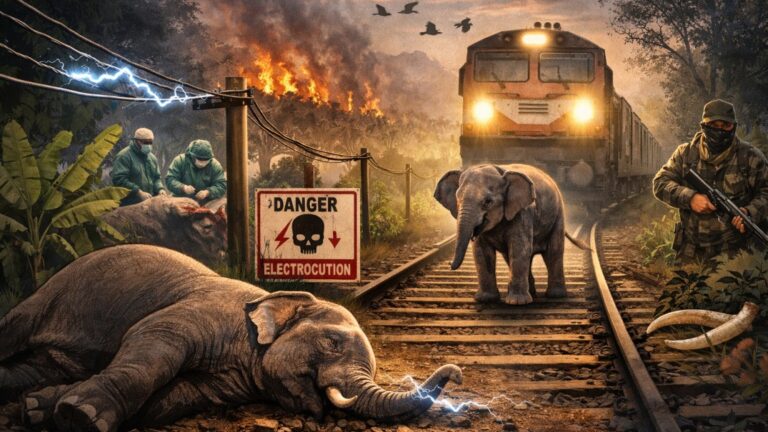
- Odisha lost 136 wild elephants in 18 months, averaging more than seven deaths a month, from causes that include electrocution, disease, train collisions and poaching.
- Electrocution is the leading killer, largely due to illegal electric fencing and poorly maintained power lines in elephant landscapes.
- Experts warn that weak enforcement, poor inter-departmental coordination and delayed response are turning Odisha into a high-risk state for elephants.
It was around 11.30 pm on November 1 when an adult wild elephant wandered onto the railway track between two gates near Jogal railway station in Odisha’s Mayurbhanj district. Villagers spotted the tusker and attempted to guide it away, but with the gates closed, the animal was trapped. Moments later, a speeding train struck and killed it.
Such incidents are no longer rare in Odisha.
Between April 2024 and September 2025, the state recorded the deaths of 136 wild elephants, according to data from the forest ministry. This translates to an average of more than seven elephant deaths every month, making Odisha one of the most dangerous landscapes for the species in India today.
The causes range from electrocution and disease to train collisions and poaching—but many of these deaths are preventable.
Death by Electrocution: The Biggest Threat
Electrocution has emerged as the single largest cause of elephant deaths in Odisha, claiming 42 lives in just 18 months.
One of the most heartbreaking cases was that of Ramu, a well-known 40-year-old elephant from Chandaka Wildlife Sanctuary near Bhubaneswar. Gentle and familiar to both forest staff and local communities, Ramu had never harmed anyone. In August 2024, his body was found lying in a trench, with clear burn marks on his trunk. Forest officials believe he may have attempted to pluck bananas when his trunk came into contact with illegally laid live electric wires, killing him instantly.
In most cases, villagers install low-hanging electric lines around their fields at night to deter crop raids by elephants and remove them before dawn. This practice leaves little evidence behind and almost no accountability. In other instances, elephants have been electrocuted by sagging power conductors while moving across landscapes fragmented by human infrastructure.
Read More: India Has Fewer Elephants Than We Thought, Finds First DNA Survey
Disease and Infections
Disease accounted for the deaths of 31 elephants during this period. Post-mortem examinations in several cases revealed infections, organ failure, and other underlying health conditions that often remain undetected until it is too late.
Limited veterinary capacity at the field level, coupled with the difficulty of monitoring free-ranging herds across vast and rugged terrain, continues to hinder early diagnosis and timely treatment.
Train Collisions
Railway tracks cutting across elephant habitats have long been a known risk. Yet, elephants continue to die on them.
In October 2024, a calf was killed in a train collision near Rourkela, despite advance warnings to railway authorities about herd movement in the area. Officials later attributed the incident to miscommunication between the forest department and the railways. Another elephant injured in the same accident survived and was shifted to Nandankanan Zoo in Bhubaneswar for treatment.
Over the last 18 months, four elephants have died in train collisions. This is particularly troubling because many of these railway stretches lie along traditional elephant corridors that are already mapped and monitored. Measures such as speed restrictions, better lighting, and early warning systems exist on paper—but the deaths continue, raising questions about implementation and coordination.
Read More: Growing a Forest for Odisha’s Elephants
Natural Causes and Other Deaths
Another 31 elephants were recorded as having died from natural causes, including old age and health conditions with no evidence of human interference. While natural mortality is expected in any wild population, its impact becomes far more serious when combined with high levels of avoidable deaths.
Poaching accounted for four elephant deaths during this period.
In 20 cases, the cause of death could not be determined because the carcasses were too decomposed to yield clear evidence—highlighting gaps in monitoring and rapid response.
Odisha is home to 2,103 elephants, according to the latest elephant census conducted in November 2024. While the population remains significant, the scale and nature of recent deaths point to a species under increasing pressure from human activities, weak enforcement, and infrastructural conflict.
Unless urgent steps are taken—stronger regulation of illegal electrification, better coordination between departments, improved veterinary capacity, and real accountability—Odisha’s elephants will continue to pay the price.
Species At a Glance: Asian Elephant
Scientific name: Elephas maximu
Common name: Hathi
IUCN Status: Endangered
Population: Approximately 22, 446 in India (as of All-India Synchronous Elephant Estimation (SAIEE) 2025)
Range: India, Sri Lanka, Nepal, Bhutan, Bangladesh, Myanmar, Thailand, Laos, Cambodia, Vietnam, Malaysia, Indonesia
Habitat: Tropical and subtropical forests, grasslands, scrub forests, and human-dominated landscapes
Major Threats: Habitat loss and fragmentation, human–elephant conflict, linear infrastructure (roads, railways, power lines), poaching, climate-related stress
Conservation Status in India: Protected under Schedule I of the Wildlife (Protection) Act, 1972; included in Project Elephant
Ecological Role: Keystone species that shapes forest structure and aids seed dispersal