Quick Glance
- Scientists discovered a new flounder species, Pseudorhombus bahudaensis, in Odisha’s *Bahuda Estuary.
- It was long mistaken for P. arsius, but DNA and morphology showed they diverged 17 million years ago.
- The new species is likely endemic and underscores the need for accurate identification in fisheries management.
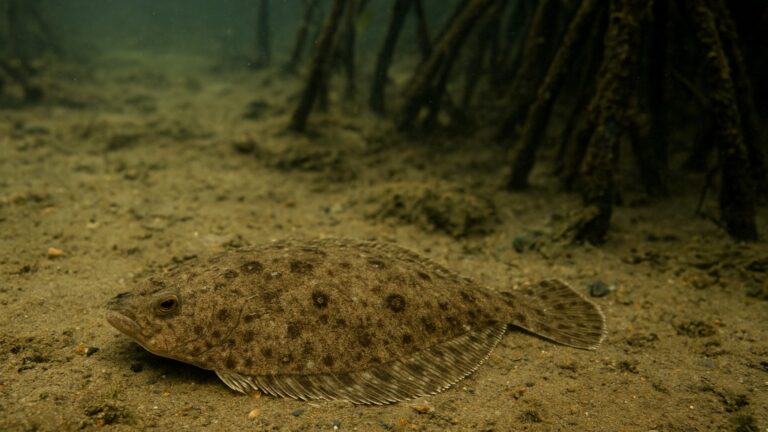
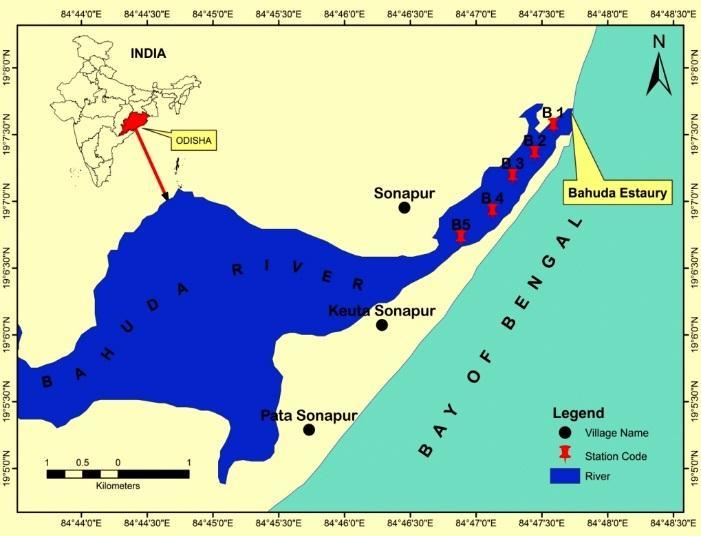
Along the silty banks of the Bahuda Estuary of Odisha, where river meets sea and light filters through a matrix of mangrove roots and shifting mud, a flounder has been quietly playing hide-and-seek with science.
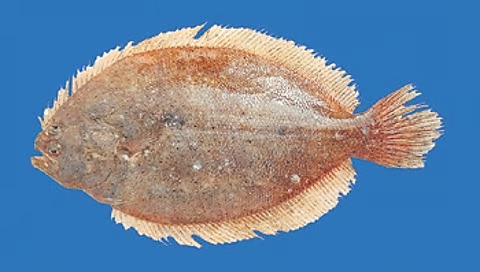
For decades, this flat, brown-spotted fish swam under the name Pseudorhombus arsius — the commonly known Gangetic large-tooth flounder. Now, thanks to a combination of DNA analysis, morphology and patient fieldwork, researchers at the Zoological Survey of India have unmasked it to be a different species: Pseudorhombus bahudaensis, a fish with its own deep lineage and its own story to tell.
Different Fish at Molecular Level
The Flounders are a widely distributed, commercially important fish found in India, Sri Lanka, Malaysia, the Philippines, northern Australia, and extending west to the Persian Gulf and east to Papua New Guinea. They are unique looking with both eyes on the left side of the body, bottom dwelling, found at depths of 10–100 meters, often near river mouths and shallow bays. They can tolerate brackish water too, so sometimes enters estuaries and mangrove areas.
Till recently the flounder found in Odisha’s Bahuda estuary were thought to be the wide-ranging species Pseudorhombus arsius but researchers combined morphological, morphometric, and molecular analyses over the course of a year to find that it was a different species.
Read More: World’s Largest Cave fish Discovered in India
It turns out that the genetic roots of the two species diverged some 17 million years ago. That is far older than the human lineage’s split from our ape cousins. To the naked eye, the two fishes looked much the same but the molecular data whispered a different script.
Lead scientist Anil Mohapatra believes this to be a very important scientific discovery as it showcases the importance of integrating molecular data with classical taxonomy to reveal differences of supposedly similar looking species. Notably, the Bahuda lineage does not genetically match any P. arsius sequences available in global databases, underscoring its novelty and endemic nature.
Why does this matter?
Estuaries as Thriving Habitats – The Bahuda lineage of the Flounder fish does not just rewrite taxonomy — it rewrites how we see coastal biodiversity. Estuaries like these are shifting borders between fresh and salt water, land and sea. They are often treated as “nursery zones” where fish, frogs and turtle newborns begin their lives. But here, in one such liminal landscape, an entirely new species was hiding.
Sustainable Fishing – From the commercial exploitation point of view, this has direct implications for fisheries management. Flounders are commercially valuable species and accurate species identification helps in ensuring sustainable exploitation. If you mis-label your catch as “P. arsius” when in fact you’re pulling “P. bahudaensis”, then regulation, conservation and sustainability all wobble.
The discovery is a reminder that the map of our world is still very generic. The further we peer, the more we might find the cousins overlooked that might look the same on the surface but hold completely different identities at the genetic level. It is also a challenge to look at every estuary, every muddy area and assume that there could be a whole new world waiting to be discovered in that small habitat too.
Read More: How to Save a Fish that Looks and Acts Like a Snake
Featured image is AI generated and for illustrative purpose only

One thought on “A New Species of Flounder, Hiding in Plain Sight in Odisha”