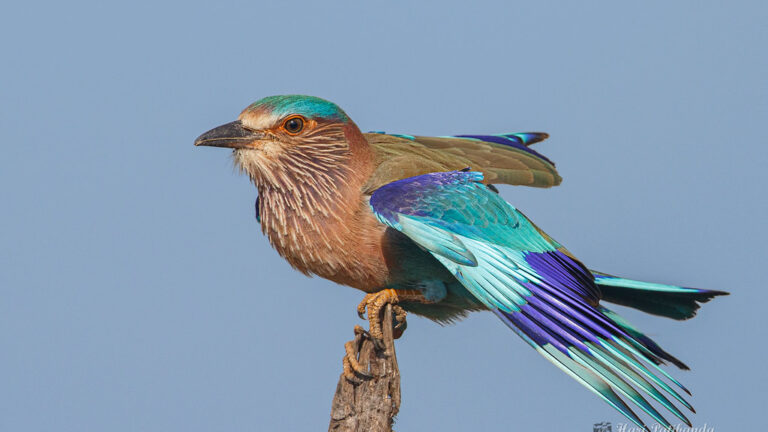
The Indian Roller (Coracias benghalensis) is a bird found across India. Commonly known as the Neelkanth or Palapitta, it is often seen perched on wires around agricultural fields or roadsides — its distinct blue plumage making it hard to miss. But over the past 12 years, this once-common bird has slowly become less so, leading the International Union for Conservation of Nature (IUCN) to upgrade its status from ‘Least Concern’ to ‘Near Threatened’. This change signals that the population decline in India is serious enough to warrant increased conservation efforts.
The Indian Roller performs magnificent rolling and tumbling acrobatics in the sky. It somersaults, rolls from side to side, and nose-dives while flashing its brilliant blue colours in the sunlight — hence the name ‘Roller’. Its Hindi name, Neelkanth, is an ode to the neela or vivid turquoise/blue on wings and belly with a cinnamon/buff body.The bird holds cultural significance and is the State Bird of Odisha, Telangana, and Karnataka — a reflection of its wide range across India.
Unfortunately, scientists have recorded a 30% decline in the Indian Roller’s population over the last 12 years, prompting the IUCN to reclassify it as ‘Near Threatened’. The main cause? The deliberate capture and mistreatment of the birds during festival seasons, especially during Durga Puja and Dussehra, according to the State of India’s Birds 2023 report.
Misguided Belief, Deathtrap for a Bird
In several states, including West Bengal, Odisha, Andhra Pradesh, and Telangana, it is considered auspicious to sight an Indian Roller on the final day of Puja or Dashami. Exploiting this belief, bird catchers trap Rollers before Dussehra — gluing or tying their wings, binding their feet, and displaying them for a fee. Rollers typically feed on insects and rodents, but the captors, unaware of their diet, often feed them fruits or vegetables. In the pursuit of bringing good fortune to others, many Rollers tragically meet cruel and untimely ends.
Pradeep Nair of the Animal Warriors Conservation Society told The Hindu,
“Temples increasingly engage poachers to capture Palapittas (Rollers) for devotees. These migratory birds normally feed on insects across fields, but their natural visibility is declining due to habitat loss and urbanisation. The birds suffer greatly when confined to small cages and exposed to human touch, often dying from dehydration, organ failure, or trauma.”
Protected but Still at Risk
Of the 1,300 bird species found in India, 178 have been prioritised for protection — and the Indian Roller now joins this list. Faced with habitat loss, urbanisation, and the threat posed by misinterpreted cultural traditions, the blue bird of India urgently needs our collective attention and protection.
Ironically, even before its IUCN status was upgraded, the Indian Roller was already protected under Schedule II of the Indian Wildlife (Protection) Act, 1972. This law prohibits the capturing, caging, or display of Indian Rollers. Offenders face up to three years of imprisonment and fines of up to one lakh rupees, with harsher penalties for repeat violations. Yet despite these legal safeguards, poachers continue to exploit the festive season to trap and sell the birds.
Featured image via cc/Flickr


One thought on “Indian Roller Declared ‘Near Threatened’ After Sharp Population Decline”