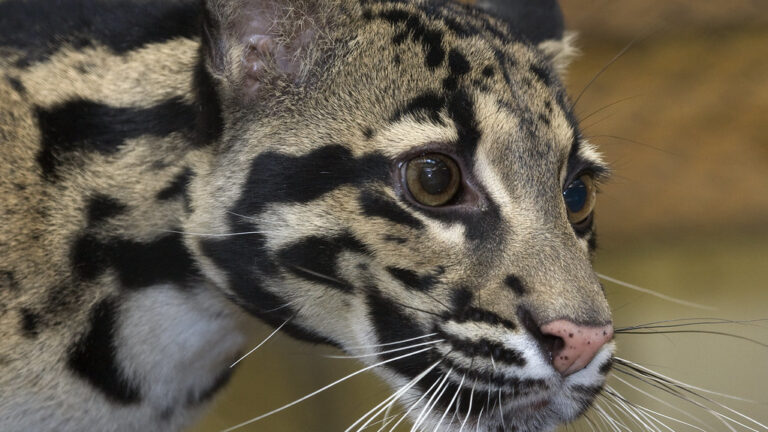
India is home to several big cats – the Tiger, Asiatic Lion, Leopard and the Snow Leopard. But hidden in the same forests are other wild cats – smaller in size – but no less important.
To understand where these small cats live and their present occupancy status, the Wildlife Institute of India (WII) recently published for the first time, a report based on the camera trap data of these species collected during the 2018 and the 2022 all-India Tiger Estimation.
This comprehensive small wild cat report presents the occupancy status and dynamics of nine small cat species across India’s tiger-range forests.
The species are:
- Jungle Cat
- Leopard Cat
- Asiatic Golden Cat
- Caracal
- Clouded Leopard
- Rusty-spotted Cat
- Fishing Cat
- Asiatic wildcat / Desert Cat
- Marbled Cat
While exact population census for these individual small cats in India can be tricky because of their elusive nature, the occupancy status is the next best thing, providing a crucial baseline for the next steps in targeted conservation.
Key Insights
The report reveals that the Jungle Cat is the most widespread small wild cat species in the Indian jungles, followed by the Rusty-spotted Cat and then the Leopard Cat. The other key takeaways from the small cat survey are:
- Occupancy rates are significantly higher within protected tiger reserves, reinforcing the conservation value of Project Tiger landscapes as biodiversity umbrellas.
- Generalist species like Jungle Cats and Rusty-spotted Cats maintain occupancy even in human-modified landscapes; whereas specialists like the Fishing Cat depend on intact wetlands and dense forests and decline sharply with disturbance.
- Wetlands and the Northeast India hill forests act as critical strongholds for rarer species.
- Caracals, the rarest of India’s wild cats, have remained undetected and require urgent investigation.
Here are a few more details about each of the 9 small cat species as per the WII report:
Jungle Cat
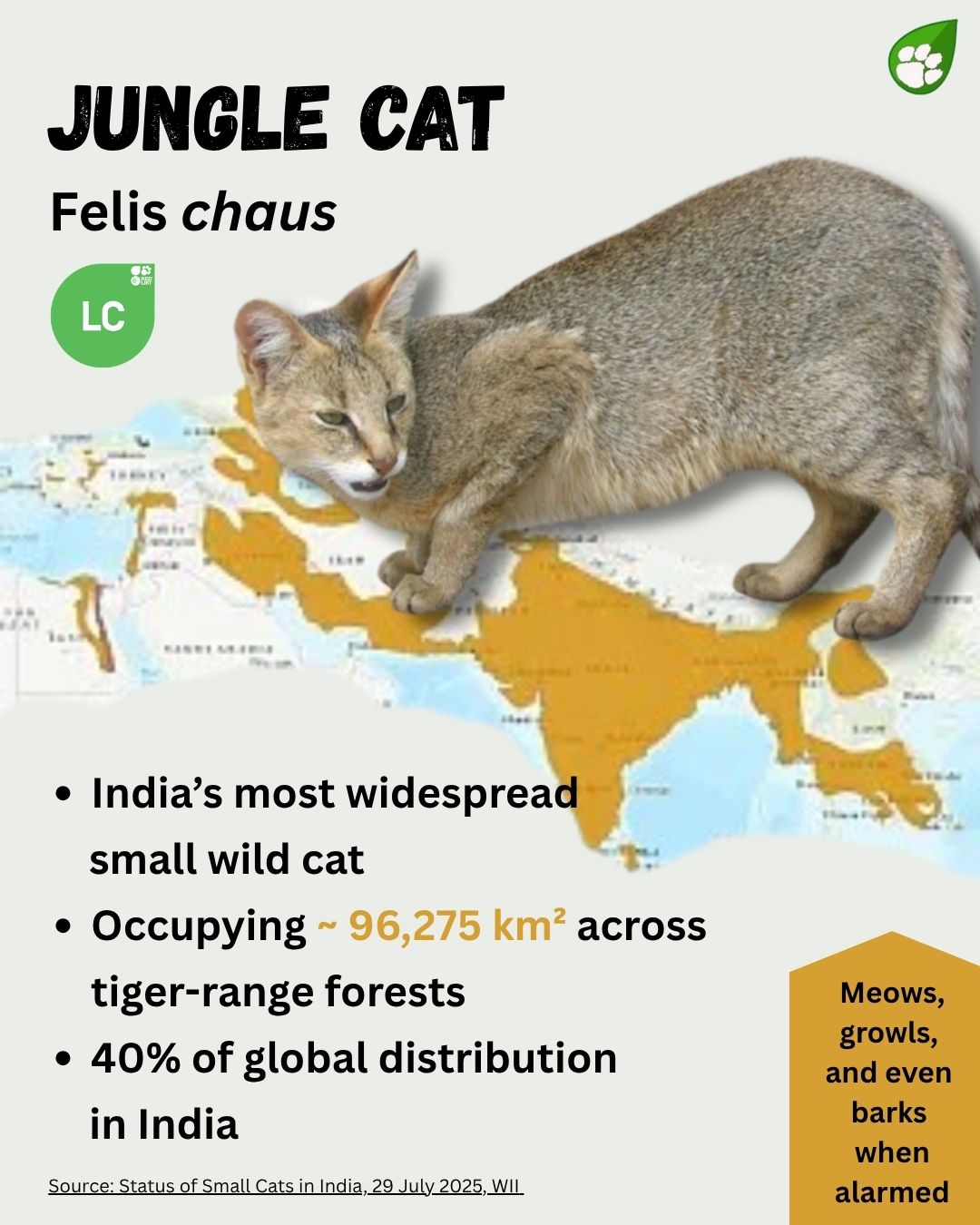
The Jungle Cat emerged as the most widespread species, occupying an estimated 96,275 km² across diverse habitats, ranging from dry deciduous to moist forests. This adaptable wild cat species in India is found in wetlands, grasslands, and scrub forests. The highest occupancy was in Central India.
Spotted in Andhra Pradesh, Arunachal Pradesh, Assam, Bihar, Chhattisgarh, Jharkhand, Kerala, Karnataka, Maharashtra, Madhya Pradesh, Odisha, Rajasthan, Telangana, Tamil Nadu, Uttarakhand, Uttar Pradesh, and West Bengal.
IUCN Status: Least Concern
Rusty-Spotted Cat
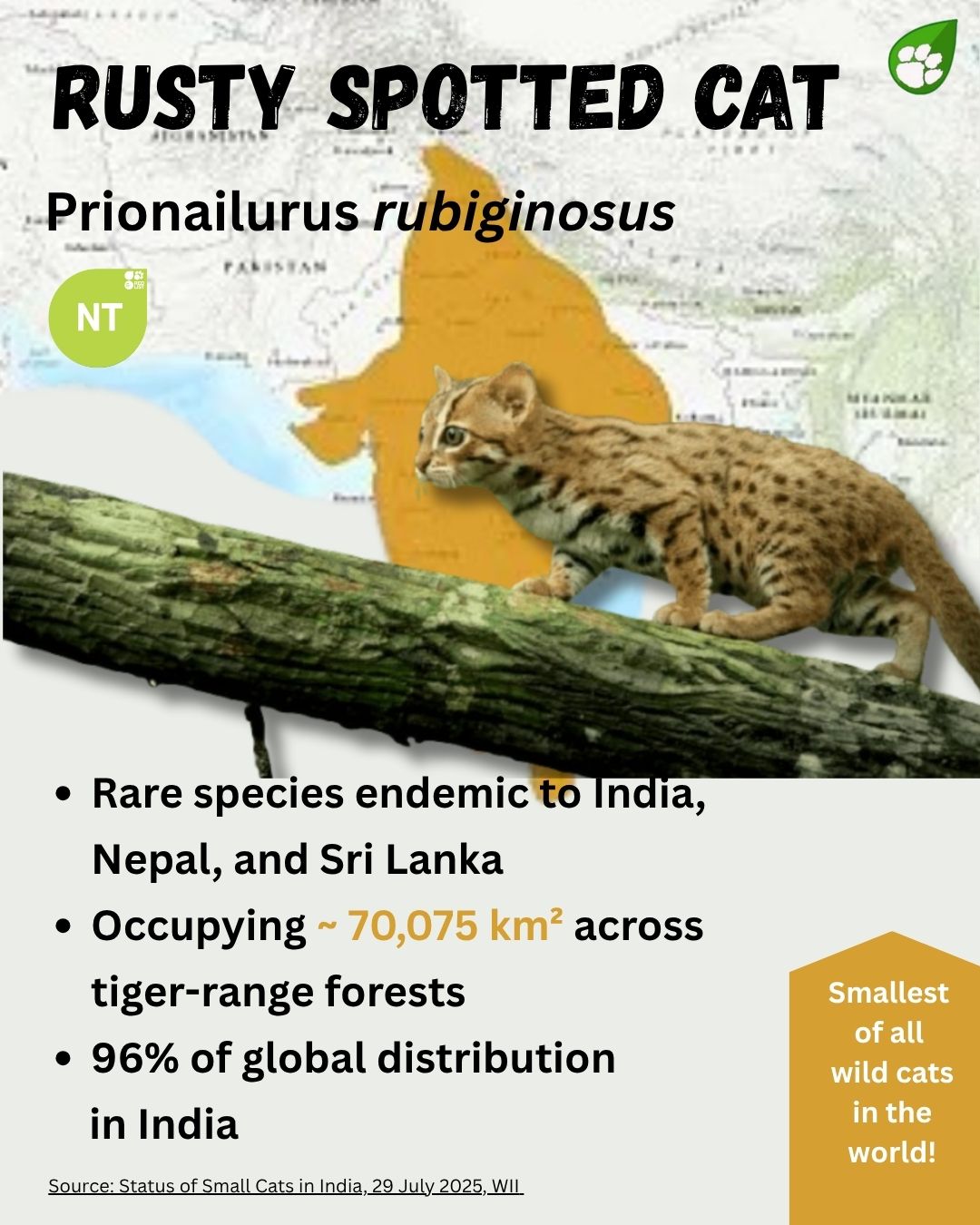
The world’s smallest wildcat, the Rusty-spotted Cat is the second most widespread small cat in India, occupying 70,075 km². Endemic to India, Nepal, and Sri Lanka, it prefers tropical dry forests, moist deciduous, and thorn forests.
High occupancy was observed across the Western Ghats, Deccan Peninsula, Himalayan foothills, Gangetic Plains, and Semi-arid regions. Seen during the survey in multiple states including Andhra Pradesh, Karnataka, Maharashtra, and Tamil Nadu.
IUCN Status: Near Threatened
Read More: Rusty Spotted Cat seen in Uttar Pradesh Reserve after a Decade
Leopard Cat
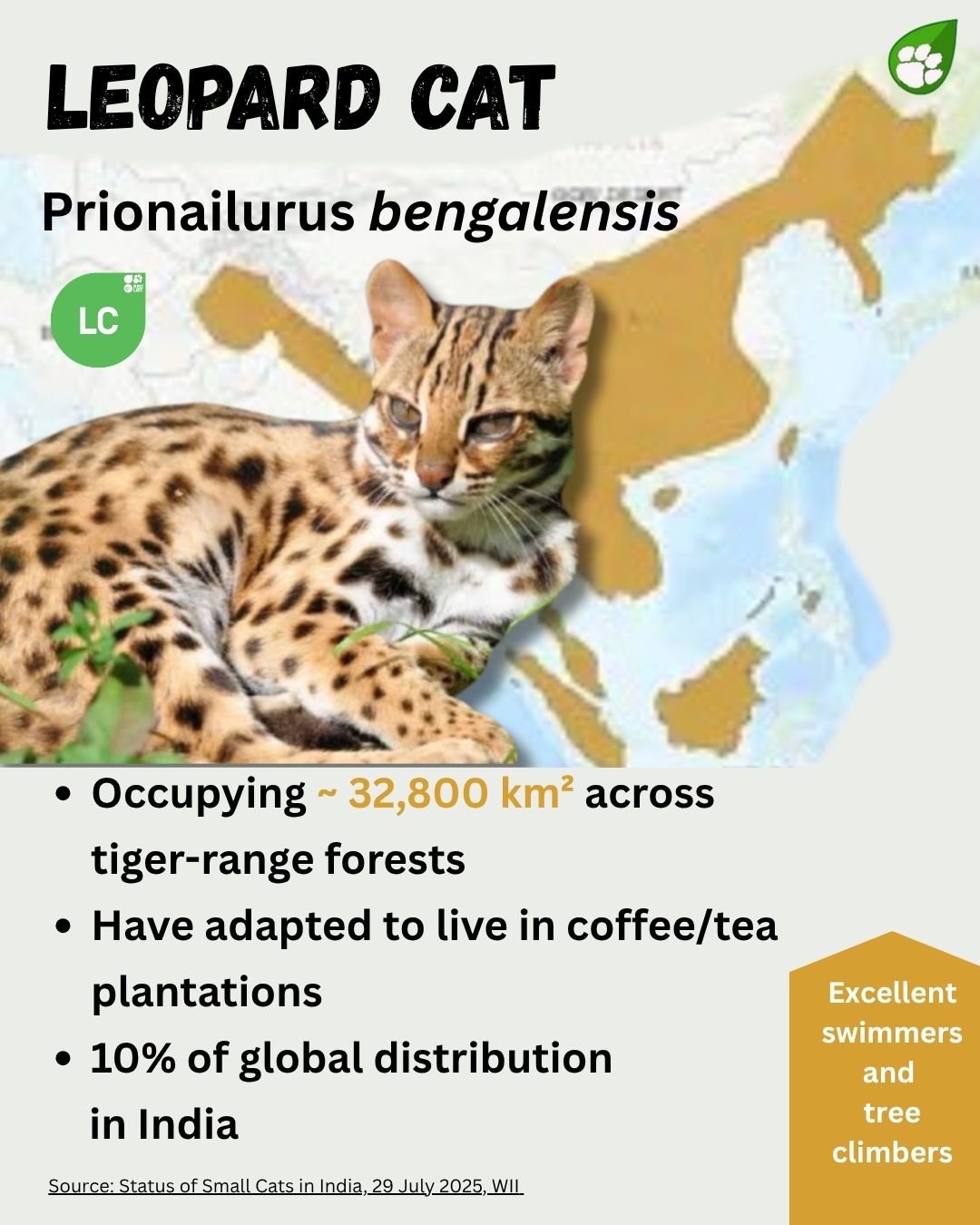
This elusive cat species in India prefers moist forests and occupied 32,800 km², particularly in the Himalayan foothills, Northeast, Sundarbans, and parts of the Western Ghats.
Leopard Cats have shown adaptability to agricultural landscapes, tea/coffee plantations, and areas near human settlements. Moderate to high occupancy was recorded in Corbett, Rajaji, and Valmiki.
Seen in Arunachal Pradesh, Assam, Bihar, Kerala, Mizoram, Odisha, and more.
IUCN Status: Least Concern
Desert Cat (Asiatic Wildcat)
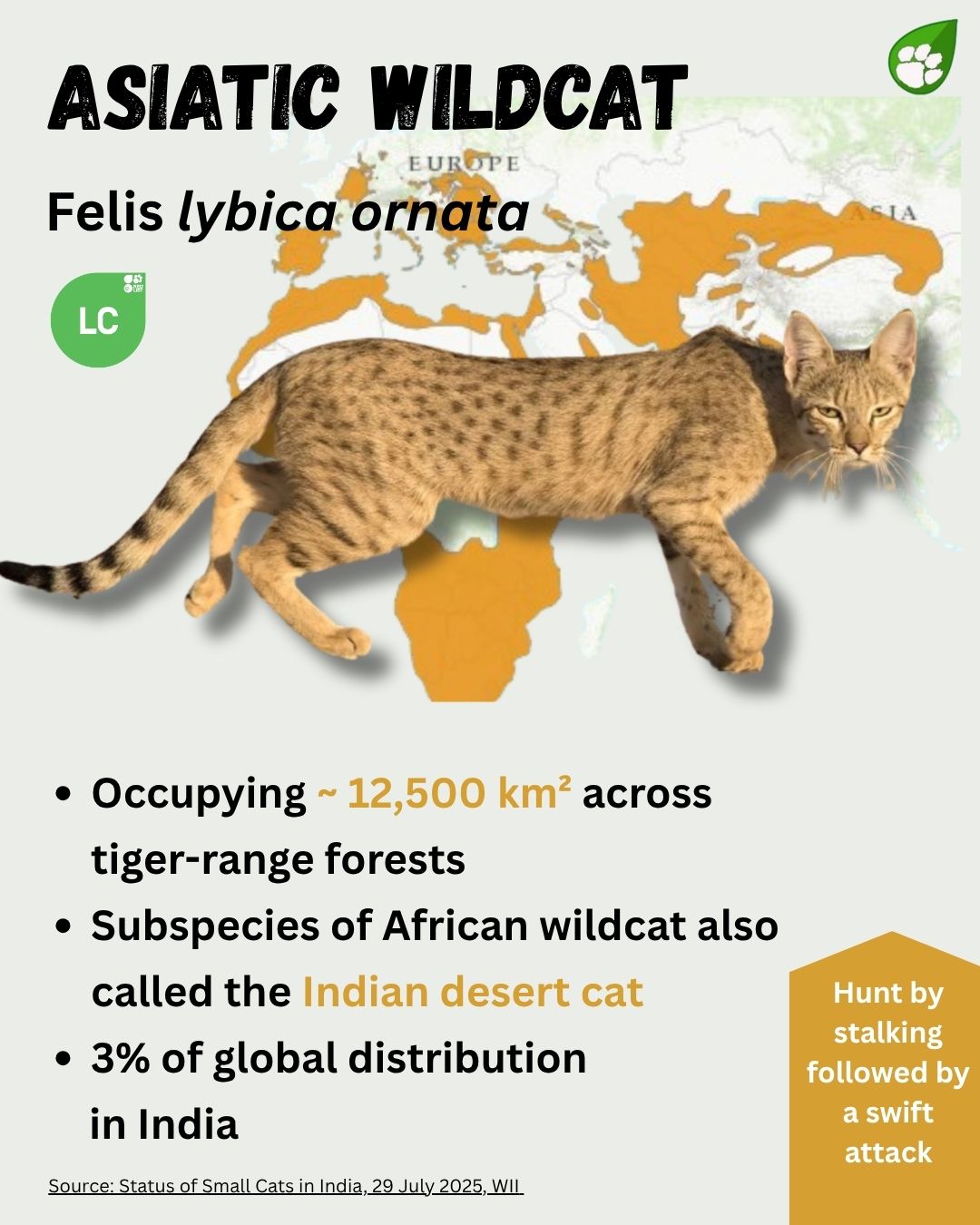
Native to arid and semi-arid landscapes, the Desert Cat in India was recorded across 12,500 km². It thrives in habitats like the Thar Desert, Rann of Kutch, and Banni grasslands.
Highly adapted to hot climates and low water conditions, it has been photographed in Rajasthan, Madhya Pradesh, and parts of Maharashtra.
IUCN Status: Least Concern
Fishing Cat
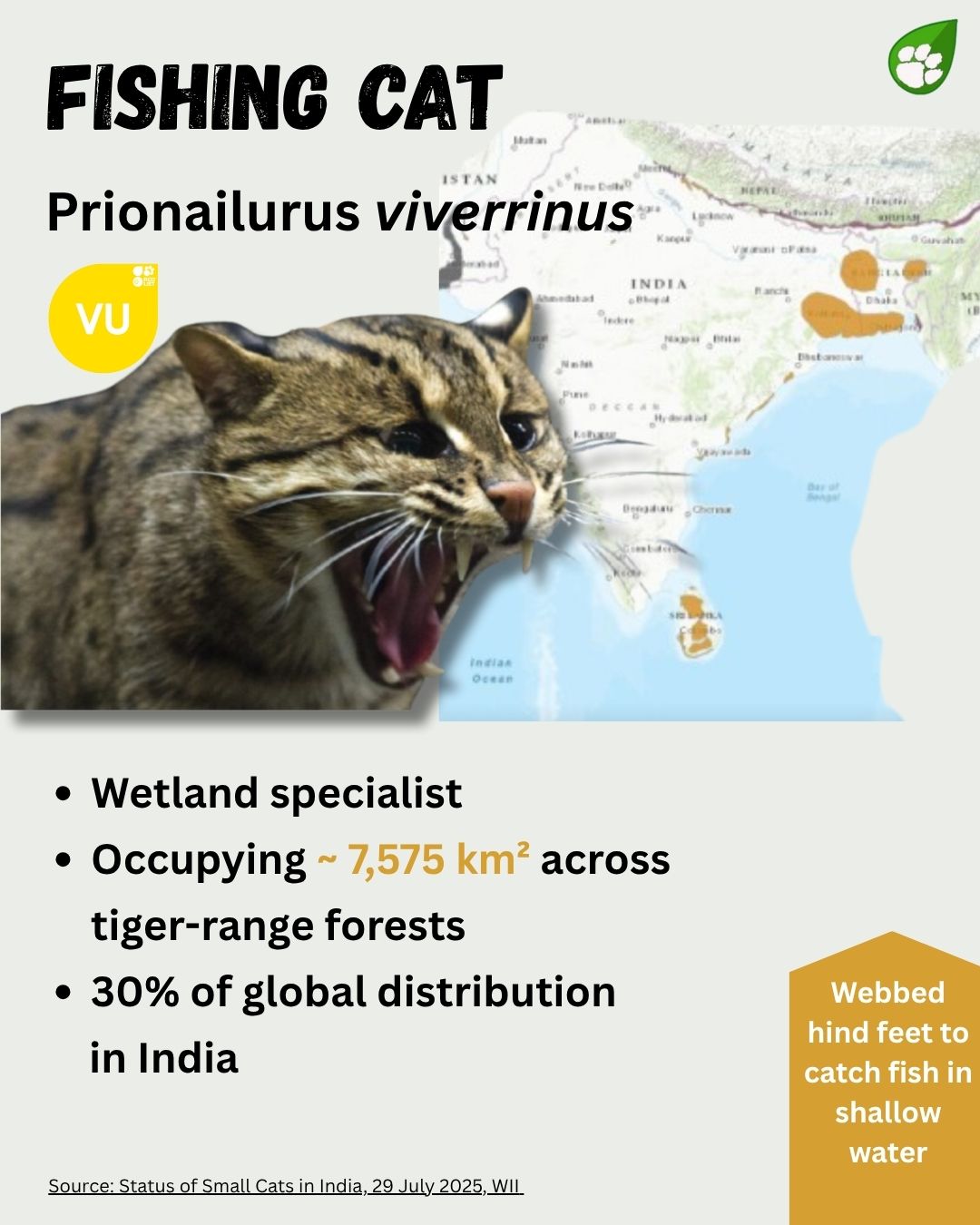
Closely tied to wetlands, this wild cat in India was recorded in 7,575 km² primarily across the Terai, Northeast India, and Sundarbans.
Fishing Cats are semi-aquatic and have webbed feet that help them hunt aquatic prey. Key habitats include mangroves, floodplains, and riverbanks.
Seen in Assam, Bihar, Uttar Pradesh, and West Bengal.
IUCN Status: Vulnerable
Read More: Interview Tiasa Adhya, Fishing for the Fishing Cats
Clouded Leopard
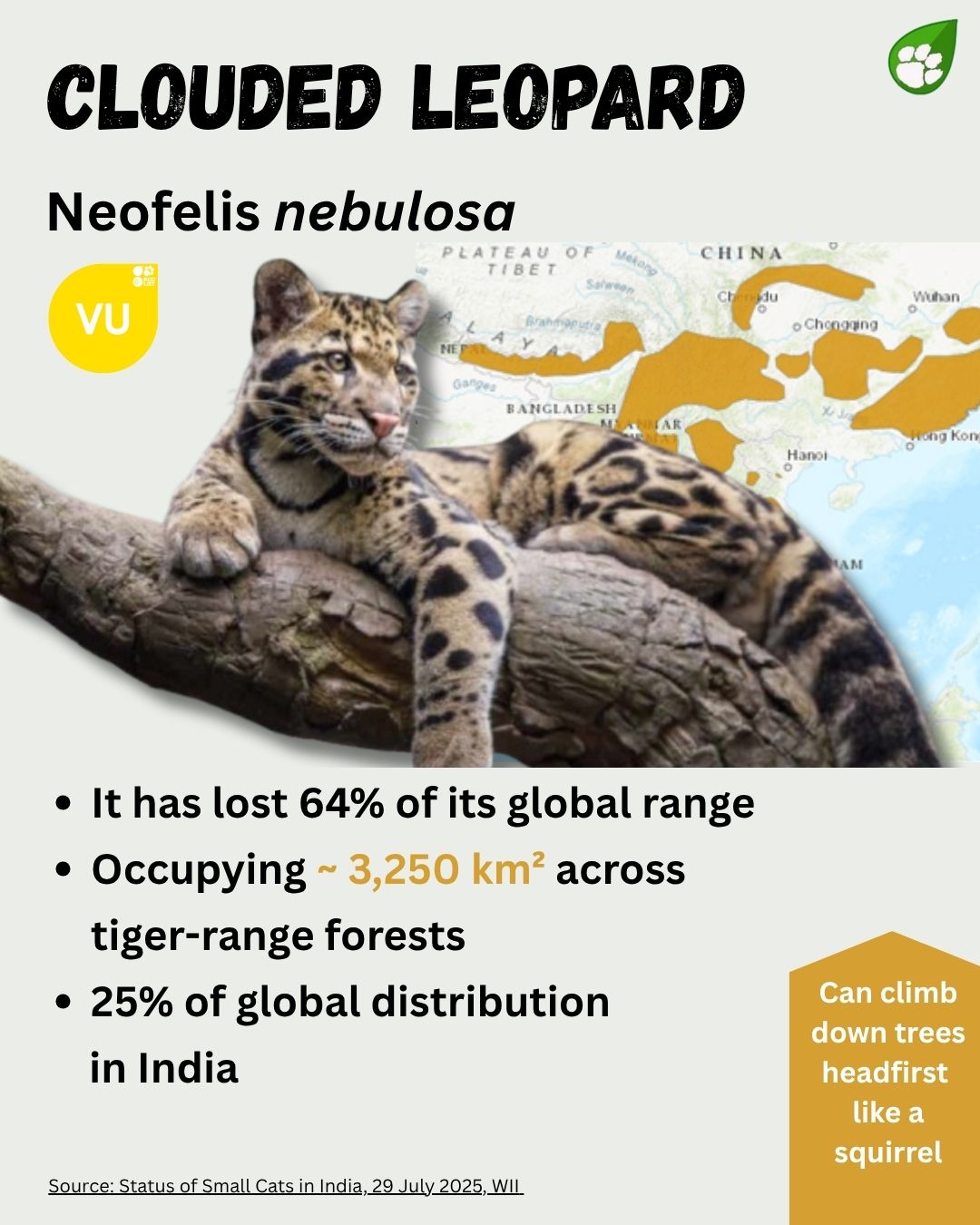
Although large-bodied, the Clouded Leopard is classified as a small cat due to its inability to roar and structural similarities with small cats.
In India, it was found in just 3,250 km², mainly in the Northeast hill forests and protected areas in states like Arunachal Pradesh, Mizoram, and Sikkim. It has lost over 60% of its global range and is often trafficked illegally.
IUCN Status: Vulnerable
Marbled Cat
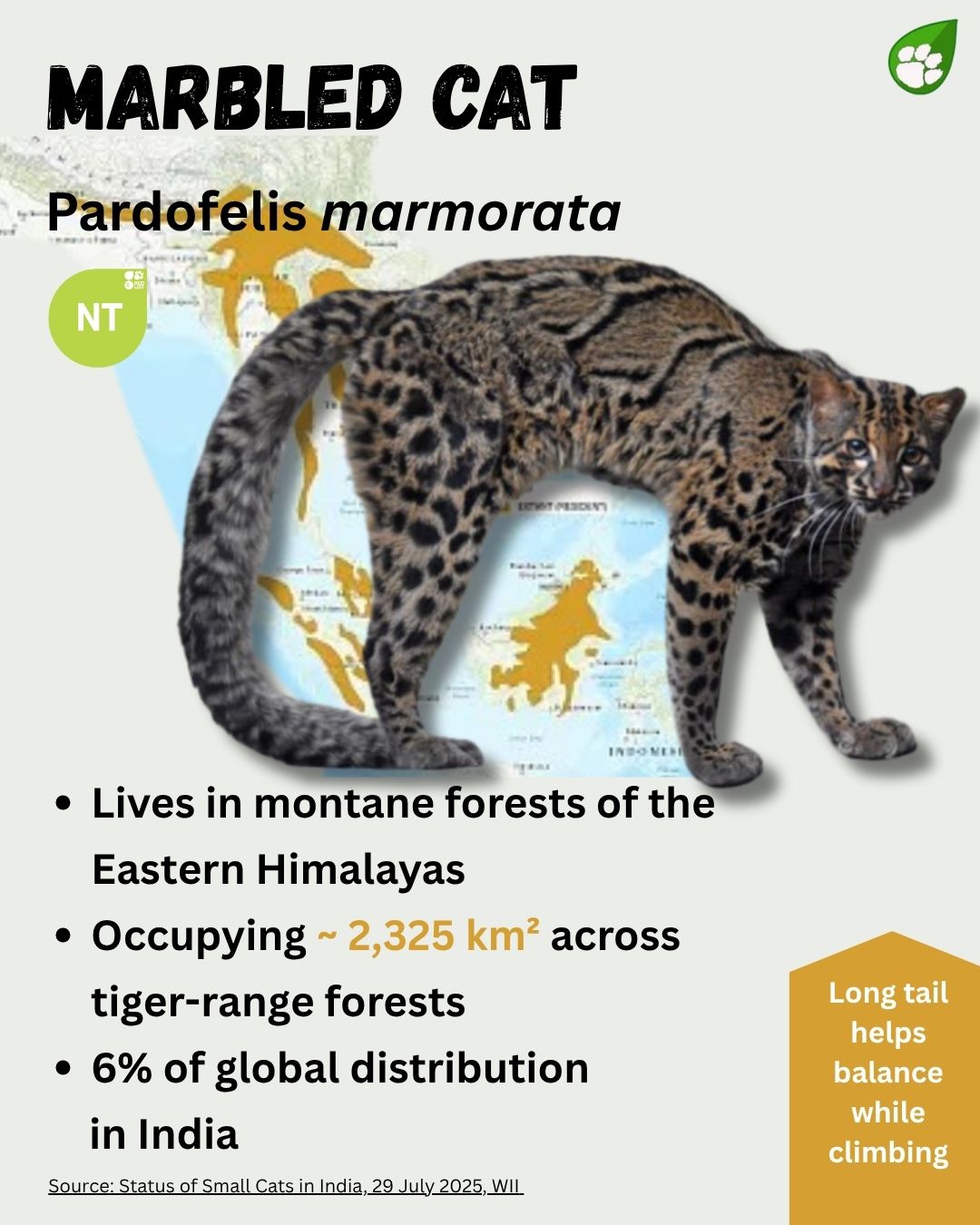
One of the most elusive and least studied small cats in India, the Marbled Cat is found in West Bengal, Assam, Nagaland, and Arunachal Pradesh. It was recorded across only 2,325 km².
It resembles a miniature clouded leopard and is highly arboreal with excellent climbing ability. This species is still poorly understood.
IUCN Status: Near Threatened
Asiatic Golden Cat
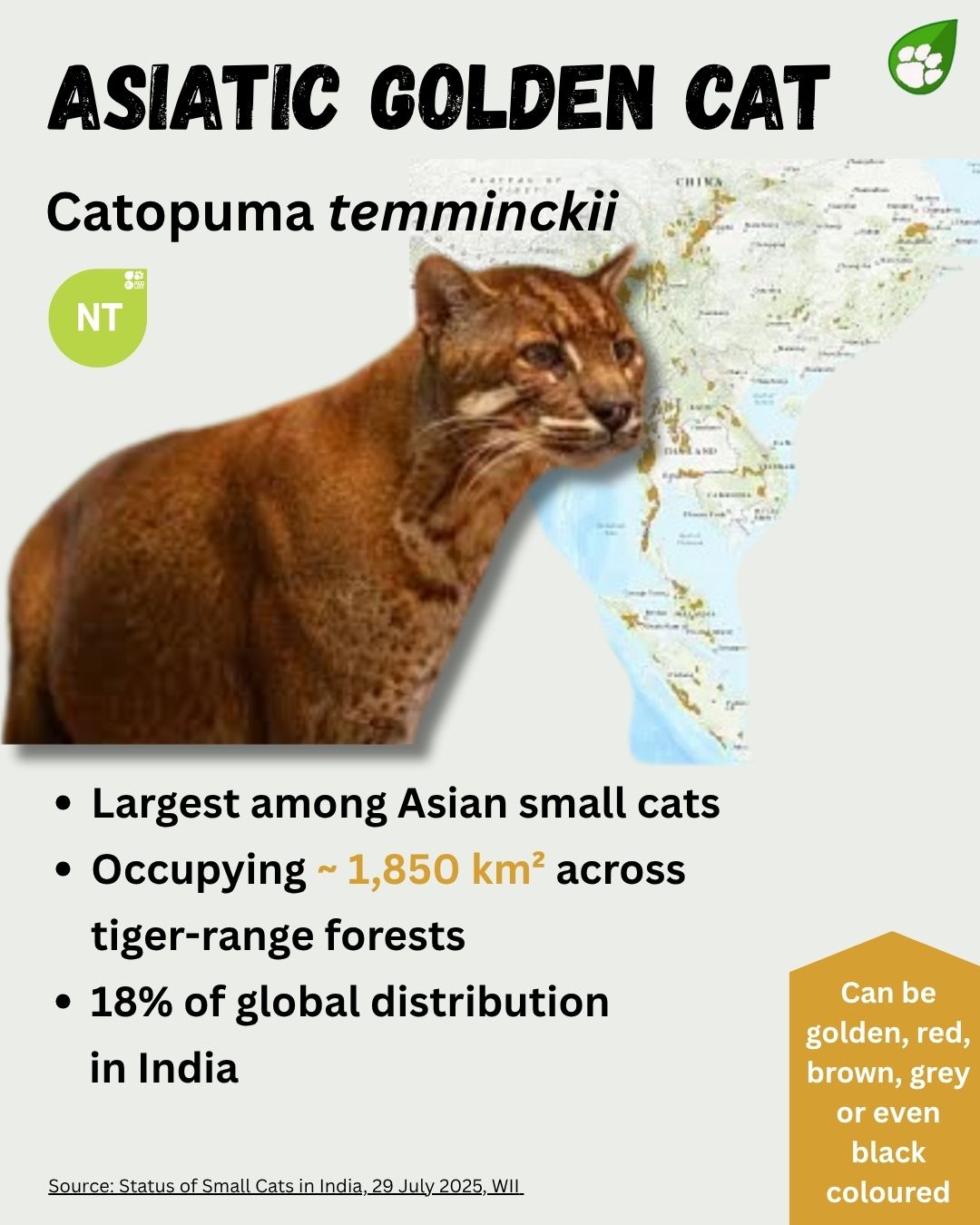
The largest among Asia’s small wild cats, the Asiatic Golden Cat is polymorphic and was found in just 1,850 km² in India’s Northeast.
Sightings were recorded in Assam, Sikkim, Mizoram, Nagaland, and Arunachal Pradesh. It has suffered major range contraction in recent decades.
IUCN Status: Near Threatened
Read More: UP Police Rescues Rare Wild Cat from Poachers
Caracal
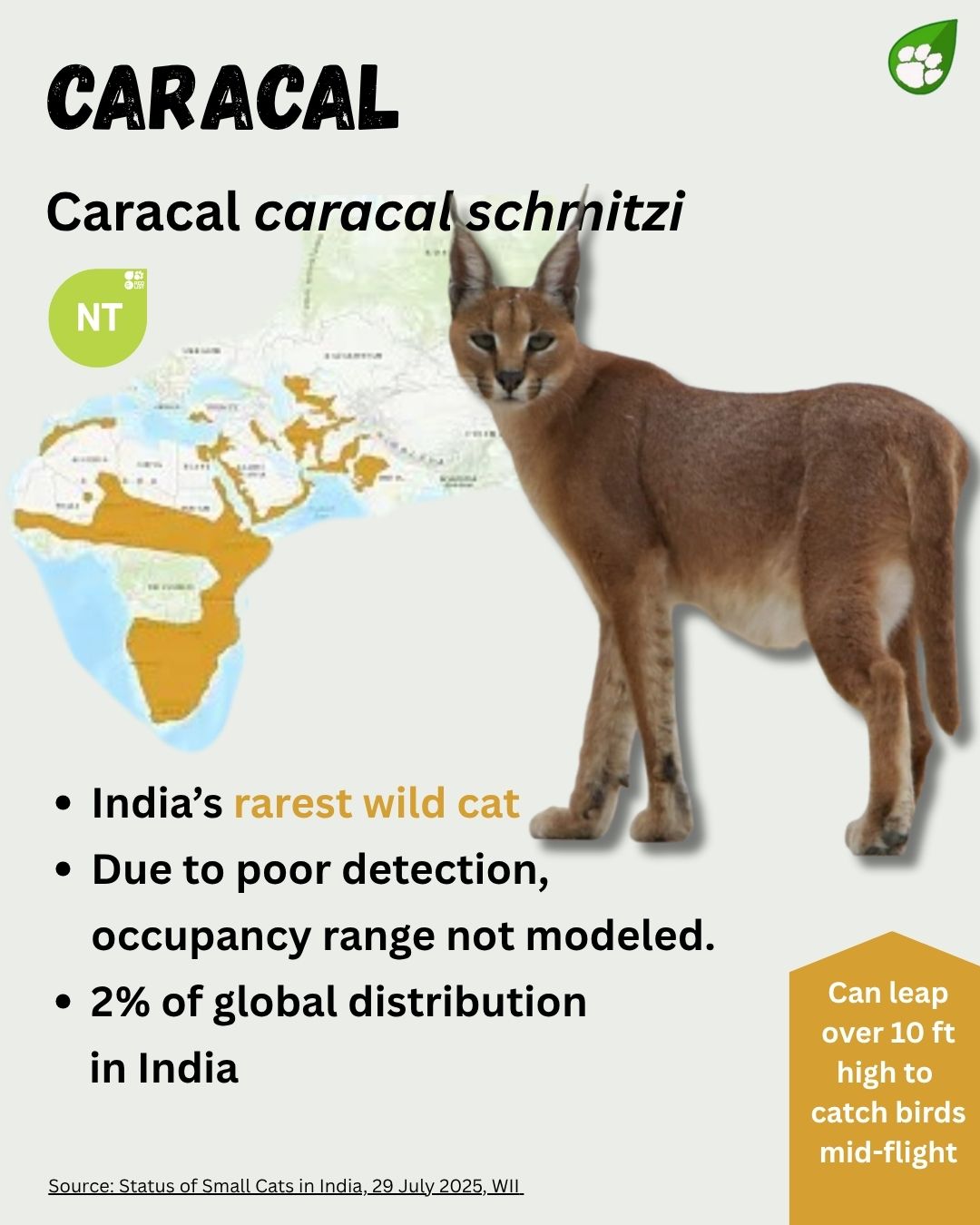
The Caracal is one of the rarest wild cats in India. It has been recorded only in Rajasthan, Gujarat, and Madhya Pradesh, and no occupancy model could be built due to insufficient detections.
This secretive, solitary cat was once trained by Mughal royalty to hunt birds. Despite its historical significance, today it is among the most threatened cats in India and in need of focused conservation attention.
This detailed report by WII sheds much-needed light on India’s small wild cat diversity, distribution, and conservation needs. Protecting these elusive species is crucial not just for their survival but for the health of India’s ecosystems.
Featured image Credit: Smithsonian Institution via Flickr/cc